I still remember the moment everything changed for saddle design. It was 2006, and I was at a cycling trade show when whispers started circulating about "that study"—research from NIOSH showing that traditional bike saddles could reduce penile blood flow by up to 82%. You could feel the collective discomfort in the room, both literal and figurative.
Within five years, the entire landscape had transformed. Suddenly, urologists were weighing in on component design. Medical pressure mapping became standard at high-end bike shops. And that weird-looking noseless saddle your friend swore by? It wasn't weird anymore—it was "clinically validated."
After three decades in cycling, I've seen countless innovations come and go. But the medical intervention in saddle design is fundamentally different. This wasn't about making bikes lighter or faster. It was about confronting an uncomfortable truth: the component we sat on for hours was causing measurable, documented harm.
Let me take you through how medical science transformed the bicycle saddle from an afterthought into one of the most innovative and researched components on your bike.
The Research That Changed Everything (And Made Everyone Squirm)
For over a century, bike saddles followed a remarkably consistent design: narrow, elongated, and unapologetically uncomfortable. The cycling culture accepted this discomfort as inevitable—serious riders simply toughed it out. We had our coping mechanisms: standing every ten minutes, endless saddle angle adjustments, strategic applications of chamois cream, and an almost ritualistic belief that the right pair of padded shorts would solve everything.
But here's what none of us wanted to admit: these weren't just comfort issues. They were medical problems.
Dr. Steven Schrader, a reproductive physiologist at NIOSH, studied police officers who spent entire shifts on bicycles. What he found was alarming enough to make even the most hardened randonneur pay attention. Traditional saddles weren't just causing temporary numbness—they were dramatically reducing blood flow to the perineum, with oxygen levels dropping by over 80% in some cases. For officers riding daily, this correlated with reported cases of erectile dysfunction and chronic genital numbness.
The breakthrough came when Dr. Schrader tested noseless saddles—designs that removed the very feature we all assumed was essential for bike control. The results were striking: perineal pressure dropped by roughly 60%, and blood flow reduction was limited to around 20%.
Suddenly, that uncomfortable conversation we'd all been avoiding had numbers attached to it. And numbers change everything.
From Lab Research to Your Local Bike Shop: How Medical Evidence Became Marketing Gold
Here's where the story gets really interesting from an industry perspective. Academic research rarely translates directly into consumer products, especially when it challenges over a century of established design. Yet within just a few years, noseless and short-nose saddles moved from experimental equipment for police departments to performance products ridden by Tour de France professionals.
ISM, a company built specifically around noseless saddle technology, didn't market their Adamo line by promising you'd climb faster or look more pro. They led with something entirely different: clinical evidence that their design solved a medical problem that urologists had quantified and documented.
This was a revolutionary marketing strategy because it bypassed the usual cycling industry skepticism. When a rider suggests a radically different saddle design, we're suspicious—we've all seen gimmicks come and go. But when a urologist recommends that same design to address numbness or erectile dysfunction concerns? That carries authority that transcends cycling culture.
I saw this transformation firsthand in my fitting studio. Pre-2005, when I suggested alternative saddle designs to riders experiencing numbness, I'd get resistance: "That looks weird," "I need the nose for control," "Real cyclists don't need gimmicks." Post-2010, those same conversations went differently: "My doctor mentioned these," "I read about the blood flow studies," "Is this the kind that prevents the pressure problems?"
The medical endorsement gave riders permission to prioritize health over tradition.
The Data Revolution: When Pressure Mapping Made the Invisible Visible
One of the most significant changes I've witnessed in professional bike fitting is the adoption of pressure mapping technology. Originally developed for medical applications like preventing hospital bed pressure ulcers, these systems use sensor arrays to create heat map visualizations showing exactly where pressure concentrates when you sit on a saddle.
Before pressure mapping, saddle evaluation was entirely subjective. I'd watch a rider's position, ask about comfort, and make educated guesses based on experience. Now, I can show them in real-time precisely where their sit bones are contacting (or not contacting) the saddle, where dangerous perineal pressure is building, and how different saddle widths change their pressure distribution.
This technology has revealed several counterintuitive truths that challenge what we thought we knew:
More padding can actually make things worse. Those heavily cushioned "comfort" saddles often allow your sit bones to sink into the foam, which causes the saddle nose to effectively push upward into your perineum. Firmer saddles that resist deformation frequently show better pressure distribution despite feeling less plush initially. I've stopped counting how many riders I've seen transform their comfort by switching to a firmer saddle.
Cutout size matters less than you think—width matters more than you imagine. A saddle too narrow to support your sit bones will cause weight to compress soft tissue regardless of how impressively large the cutout appears. Proper width is the prerequisite that makes everything else work. I've seen riders spend hundreds of dollars trying different cutout designs when the real issue was simply that they needed to go up one width size.
Your pressure map looks nothing like your friend's, even if you're the same height and weight. Individual anatomical variation is extreme. I've mapped riders of nearly identical build whose pressure distributions looked completely different due to variations in sit bone width, pelvic tilt, flexibility, and soft tissue composition. This data-driven confirmation of anatomical diversity finally provided the evidence base for what I'd observed anecdotally for years: there is no "best" saddle, only the best saddle for your specific anatomy.
Companies like SQlab have built their entire product philosophy around this pressure mapping evidence. Their "step saddle" design—featuring a raised rear section and lower nose—was developed directly from pressure studies showing this profile reduced perineal pressure compared to flat or nose-raised designs. They don't just market comfort; they provide the pressure mapping data to prove their claims.
The Gender Gap That Should Never Have Existed
I need to be direct about something that bothers me deeply: the cycling industry failed women for decades when it came to saddle design.
For most of cycling history, women's saddles were essentially men's saddles made slightly wider and offered in pink. This wasn't just lazy marketing—it reflected a fundamental failure to investigate how female anatomy interacts with bicycle saddles. We assumed that wider sit bones represented the only meaningful difference, completely ignoring different pressure distributions, soft tissue configurations, and injury patterns.
The wake-up call came from case reports that no one in the industry wanted to discuss: female cyclists requiring surgical intervention for saddle-related injuries. A 2023 study found that nearly 50% of surveyed female cyclists reported long-term genital swelling or tissue changes from saddle pressure. Some women developed such severe labial trauma that they pursued labiaplasty—not for cosmetic reasons, but to address irreversible damage from chronic saddle pressure.
Let that sink in for a moment. An activity promoted for cardiovascular health was causing sufficient soft tissue trauma to require surgical correction.
These medical case reports—published in urology and sports medicine journals, not cycling magazines—finally forced manufacturers to acknowledge that women's saddles required genuine anatomical consideration rather than cosmetic differentiation. Companies like Specialized developed technologies like their Mimic design, which uses varying foam densities to support rather than compress soft tissue. The development process involved pressure mapping studies specifically with female riders and collaboration with medical professionals specializing in female pelvic health.
This medical intervention accomplished what decades of market segmentation hadn't: it legitimized fundamental design differences based on anatomical reality. A women's saddle could now be significantly shorter, wider, and more aggressively cut-out than a men's equivalent without being perceived as a "beginner" option or compromise design.
The Adjustable Solution: BiSaddle and the Customization Revolution
Given that anatomical variation is so significant that fixed saddle shapes inevitably create pressure problems for some riders, an obvious question emerges: why not make the saddle itself adjustable?
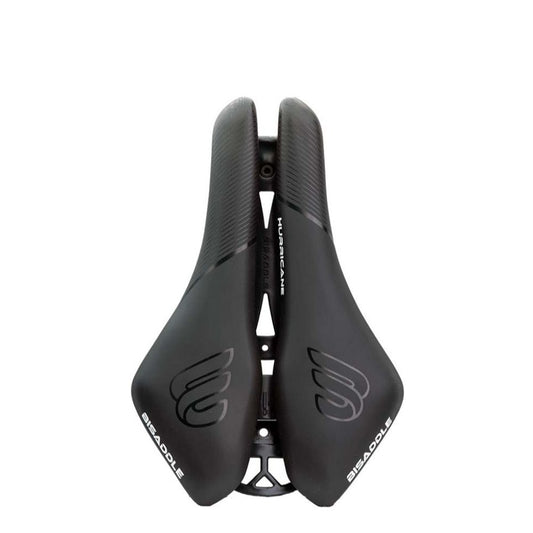
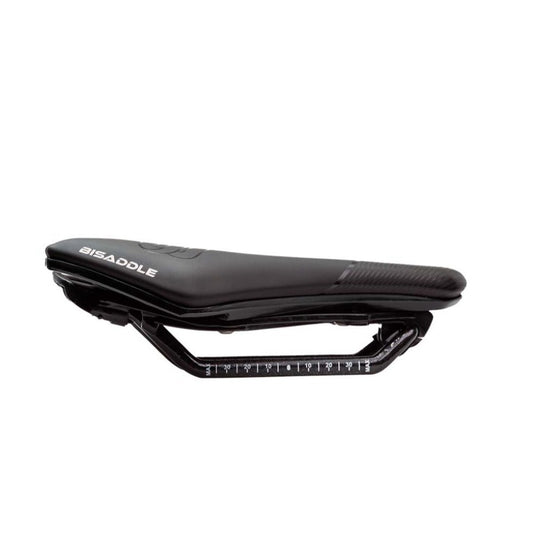
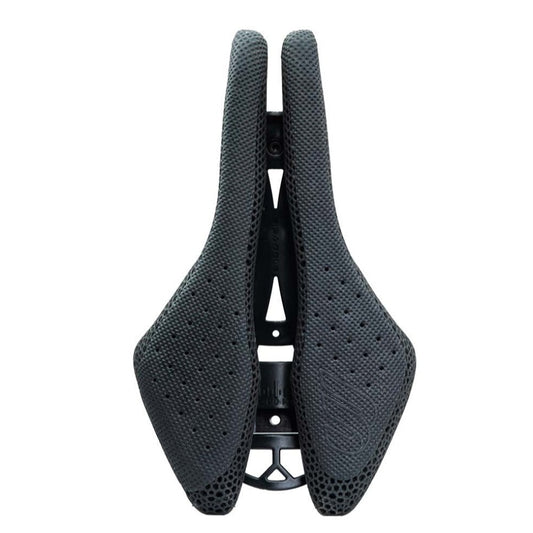
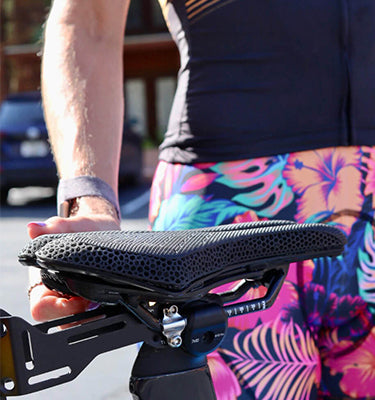
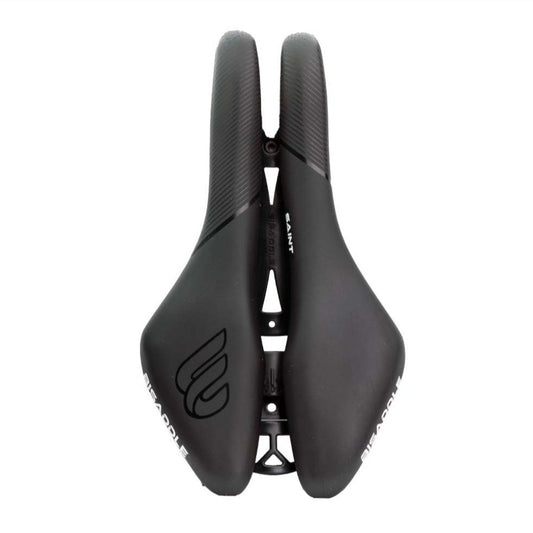
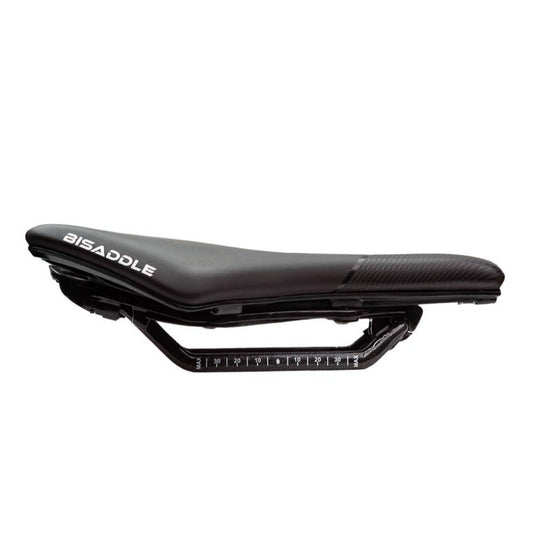
This is the premise behind BiSaddle's patented adjustable design, and it represents a distinctly different approach to solving the medical problems urologists have documented. Rather than creating dozens of fixed shapes and expecting you to find the right one through expensive trial and error, BiSaddle offers a single platform that mechanically adjusts to accommodate different anatomies.
The engineering is clever: the saddle consists of two independent halves that slide along rails to vary width from approximately 100mm to 175mm. The halves can also be angled independently, allowing you to modify the profile curvature. This adjustability directly addresses the core medical finding—proper saddle fit requires supporting your ischial tuberosities (sit bones) while minimizing perineal pressure, but the specific dimensions required vary dramatically between individuals.
From a fitting perspective, this approach aligns closely with how urologists actually recommend selecting saddles: measure sit bone width, ensure adequate support without perineal compression, and verify that soft tissue pressure remains below the threshold compromising blood flow. The traditional challenge has been that these measurements require specialized equipment and professional fitting. BiSaddle's adjustability theoretically allows you to dial in these parameters at home through systematic adjustment.
The adjustable approach also addresses something medical research has highlighted but the industry has struggled to solve: you might need different saddle configurations for different riding positions. When you're in an aggressive time trial position, your pelvis rotates forward, shifting weight from sit bones onto pubic rami and soft tissue. That same anatomy in an upright touring position loads the sit bones more directly and requires different pressure relief. Traditionally, this would mean owning multiple saddles. An adjustable design could accommodate both through reconfiguration.
BiSaddle's explicit marketing around erectile dysfunction prevention and blood flow maintenance positions the product squarely in the medical validation space. They don't lead with aerodynamics or weight—they lead with clinical concerns that urologists have documented. This represents the full maturation of medical endorsement as the primary value proposition in saddle design.
But Wait—Has the Medical Framing Created Its Own Problems?
After decades in this industry, I've learned to ask contrarian questions. While medical involvement in saddle design has undeniably produced better products, I wonder if we've overcorrected in some ways.
Are we pathologizing normal adaptation? Some discomfort during the first weeks on a new saddle is physiological—soft tissue toughens, sit bones acclimate, skin develops friction resilience. But when every instance of discomfort becomes a potential sign of dangerous vascular compromise, are we interpreting normal adaptation signals as medical emergencies requiring immediate equipment changes? I've seen riders swap saddles weekly, chasing perfect comfort that may not exist.
Have we created unrealistic expectations? The availability of professional fitting, pressure mapping, and medical-grade analysis tools has created expectations that perfect comfort is achievable through sufficiently precise saddle selection. I've worked with riders who've tried twenty different saddles, convinced that the ideal match exists if only they find the right combination of width, profile, and cutout. Sometimes, the hard truth is that long-distance cycling involves inherent discomfort that no saddle can eliminate.
The nocebo effect is real. Medical research documenting potential harms from poor saddle choice may create negative outcomes from negative expectations. A rider who learns their saddle could theoretically cause erectile dysfunction may develop anxiety-related problems independent of any actual vascular compromise. I've seen this: awareness of potential harm sometimes creates the perception or even reality of that harm through psychological mechanisms.
The innovation treadmill never stops. Medical validation as a marketing tool incentivizes companies to continually identify new medical problems their products solve. This drives innovation but also creates pressure to pathologize increasingly minor discomforts as conditions requiring technical solutions. When every new saddle launch requires medical justification, the line between addressing genuine health concerns and medicalizing normal human variation blurs.
These concerns don't negate the substantial benefits of medical involvement. They do suggest we should maintain perspective—cycling remains a fundamentally healthy activity, and most saddle discomfort represents fit issues rather than medical crises.
What's Coming Next: The Future of Medically-Informed Saddle Design
Based on what I'm seeing in research labs and prototype testing, the trajectory of medical involvement in saddle design points toward increasingly sophisticated integration of diagnostic technology and personalized prescription.
Embedded sensors and real-time feedback are already in development. Imagine saddles with integrated pressure sensors providing real-time feedback during rides. Rather than static pressure mapping in a fit studio, these systems would alert you when sustained high pressure occurs, prompting position changes or suggesting fit adjustments. This represents a shift from one-time clinical assessment to continuous medical monitoring.
AI-driven saddle selection is closer than you think. Machine learning algorithms trained on databases of rider measurements, pressure maps, and comfort outcomes could predict optimal saddle configurations more accurately than human intuition. Companies are building proprietary databases correlating rider anatomy with successful saddle choices, creating the foundation for algorithmic prescription services.
Custom manufacturing at scale combines 3D scanning technology (to capture precise anatomical contours) with additive manufacturing (to produce saddles with rider-specific geometry). This would enable true custom saddles at near-production costs—the ultimate expression of medical validation, where each saddle is prescribed specifically for an individual's anatomy based on clinical assessment.
Biometric integration explores how saddles could communicate with wearable health monitors, correlating pressure patterns with heart rate variability, sleep quality, or reported pain levels. This closed-loop feedback could enable continuous optimization based on physiological response.
These developments would cement the role of medical science not just in validating saddle designs but in actively prescribing and monitoring saddle use as a component of overall health management for cyclists.
The Bottom Line: When Your Bike Seat Became a Medical Decision
After thirty years working with cyclists of every level, from weekend warriors to WorldTour professionals, I can say definitively: the medical transformation of saddle design represents the most significant advancement in rider comfort and long-term health that I've witnessed in my career.
Medical research didn't just validate what we'd been complaining about for decades—it provided the technical language, measurement tools, and credibility framework that enabled radical design changes the cycling industry had resisted for over a century. The noseless saddle, the short-nose revolution, gender-specific anatomical accommodation, and adjustable platforms all emerged not from promises of marginal speed gains but from clinical evidence of actual harm caused by traditional designs.
The "urologist-approved bike seat" matters not because urologists have superior knowledge of cycling biomechanics—often they don't—but because their medical authority legitimizes design priorities that the cycling industry had historically subordinated to aesthetics, weight, and tradition. When a physician says "this saddle prevents measurable vascular compromise," it carries different weight than when marketing copy promises "revolutionary comfort."
For riders, this medical framing has been overwhelmingly positive. It normalized conversations about genital numbness, sexual dysfunction, and soft tissue injury that were previously taboo or dismissed as weakness. It provided permission to prioritize long-term health over short-term performance or appearance. And critically, it forced manufacturers to actually solve problems rather than simply marketing incremental variations on century-old designs.
The component you sit on has become, in many ways, a medical device—one that requires the same thoughtful, evidence-based selection as any intervention affecting your vascular and reproductive health.
So the next time someone mocks your weird-looking saddle with its unusual shape, aggressive cutout, or adjustable wings, you can smile and share what you now know: that "weird-looking" saddle represents decades of medical research, clinical validation, and genuine anatomical consideration.
Your comfort isn't a luxury. Your long-term health isn't negotiable. And your saddle choice is no longer just about cycling—it's about medicine.
Now if you'll excuse me, I have a fitting appointment with a rider whose pressure map is going to change everything he thought he knew about saddles. That's still the best part of this job.
Have questions about saddle selection, pressure mapping, or finding the right setup for your anatomy? Drop them in the comments