Why did it take over a century to design a bike saddle that doesn't harm you? The answer reveals everything wrong with “that's just how it's always been done.”
Let me share one of the most shocking statistics in cycling: Back in 1997, researchers decided to actually measure what happens to blood flow when you sit on a traditional bicycle saddle. The results? An 82% drop in penile oxygen pressure. Eighty-two percent.
Think about that for a second. If I told you there was something in your life that cut off blood flow to your genitals by more than four-fifths every time you used it, you'd throw it in the trash immediately. Yet cyclists rode on these saddles for over a hundred years, accepting numbness, pain, and far worse as simply “the price of admission.”
This isn't a story about comfort preferences or finding the perfect cushion. This is about how an entire industry ignored measurable tissue damage until the medical evidence became impossible to wave away. And it's about the remarkable transformation that happened once engineers finally started designing saddles around human anatomy instead of century-old traditions.
The Study That Should Have Changed Everything (But Didn't—At First)
That 1997 study in European Urology should have sent shockwaves through the cycling world. These researchers weren't relying on subjective complaints or asking people to rate their discomfort on a scale of one to ten—they used transcutaneous oxygen monitoring to quantify exactly how traditional saddles compromise vascular function.
The perineum—that diamond-shaped region between your genitals and anus—contains the pudendal nerve and pudendal artery. These aren't minor anatomical features we can ignore. They're absolutely critical for sexual function, sensation, and basic comfort. When you sit on a traditional narrow saddle, especially when you're leaning forward in an aggressive riding position, you're essentially compressing these vital structures against your own pubic bone.
You know what happens when you sit on your hand until it goes numb? That tingling sensation is your nerves essentially screaming that they're being starved of oxygen. Now imagine doing that for three, four, or five hours at a time. That's what generations of cyclists just accepted as normal.
The study's conclusion was crystal clear: saddle width mattered far more than padding thickness, and supporting your sit bones (those ischial tuberosities you can feel when you sit on a hard chair) while relieving perineal pressure wasn't some luxury feature—it was a medical necessity.
So why didn't the industry change overnight?
Why Bad Designs Persist: The Iron Grip of Tradition
Here's the uncomfortable truth: the traditional saddle design that dominated from the 1880s through the late twentieth century wasn't the result of biomechanical analysis or careful anatomical study. It was essentially arbitrary—a shape inherited from the earliest safety bicycles that got locked in through a century of “that's just what saddles look like.”
Cyclists are a traditional bunch. We love heritage, classic lines, and the way things have “always been done.” Pro riders used narrow saddles, therefore narrow saddles must be correct. Never mind that those same pros were downing ibuprofen like candy and dealing with numbness—suffering was woven into the sport's mystique.
But three things finally forced a reckoning:
- Medical evidence that couldn't be ignored
- New cycling disciplines that made the old designs untenable
- Occupational health research from a completely unexpected source
Let me walk you through how each one accelerated this revolution.
The Triathlon Problem: When Racing Position Meets Anatomy
Triathletes exposed the traditional saddle's inadequacy in the most brutal way possible. In an aggressive aero position—torso nearly horizontal, arms resting on aerobars—your pelvis rotates forward dramatically. This shifts weight from your sit bones onto your pubic bone and directly onto your perineum.
On a traditional saddle, holding this position for the bike leg of an Ironman (that's 112 miles, by the way) wasn't just uncomfortable—it was anatomically impossible to do without severe vascular compromise.
Here's where it gets interesting: The solution didn't come from the cycling industry at all.
The Unexpected Heroes: Police Bicycle Patrol Officers
In the early 2000s, NIOSH (the National Institute for Occupational Safety and Health) began studying bicycle patrol officers who were spending entire eight-hour shifts on traditional saddles. The findings were genuinely alarming: significant rates of genital numbness, erectile dysfunction, and urogenital complaints that qualified as occupational injuries.
When departments switched to noseless saddles, these issues plummeted by over 80%.
This wasn't about athletic performance or personal preference anymore—this was occupational health data showing that traditional saddles were causing compensable workplace injuries. Legal departments and insurance providers got involved. Suddenly, the evidence couldn't be dismissed as a few athletes complaining about discomfort.
This research directly enabled companies like ISM to develop split-nose and noseless designs that removed the anatomical conflict entirely: no nose meant nothing to compress the perineum, regardless of how far forward your pelvis rotated.
The Short-Nose Revolution: How Road Cycling Quietly Transformed
Road cyclists faced a slightly different challenge than triathletes. Their position was less extreme, but the sheer duration of their rides—100-plus-mile centuries, multi-day tours, gran fondo events—meant even moderate pressure became devastating over time.
The industry's response was actually quite elegant: short-nose saddles.
Pioneered by designs like the Specialized Power in the mid-2010s, these saddles reduced nose length by 20-40mm compared to traditional designs. The logic was brilliant: most perineal pressure occurs when you drop into an aggressive position, rotating your pelvis forward onto the saddle nose. A shorter nose with a wider front section supports your pubic rami (the lower pelvic bones) without extending far enough forward to compress soft tissue.
What's remarkable is how quickly this design propagated through professional cycling. Initially viewed as a niche triathlon adaptation, short-nose saddles are now standard equipment for World Tour professionals.
The reason isn't comfort in the recreational sense—it's performance through sustained blood flow.
Numbness forces position changes. Position changes disrupt aerodynamics and power output. A saddle that enables holding an efficient position for an additional thirty minutes in a five-hour race delivers tangible competitive advantage. When fractions of a percent matter in professional racing, the vascular health of your perineum suddenly becomes a legitimate performance metric.
The Counterintuitive Truth About Padding
Modern saddle development increasingly relies on pressure mapping technology—essentially putting sensors between rider and saddle to see exactly where pressure occurs and how intense it is. What this revealed challenged decades of comfortable assumptions.
Adding more padding seems intuitive for comfort, right?
Wrong.
Pressure mapping showed that excessive soft padding allows your sit bones to sink down, which actually causes the saddle's center to bulge upward into your perineum. Firmer, strategically placed padding that maintains your sit bones at the proper height actually reduces perineal pressure more effectively than indiscriminate cushioning.
It's counterintuitive until you think through the mechanics. Your sit bones—those ischial tuberosities you can feel when you sit on a hard surface—are literally designed to bear weight. They're essentially the bottom of your pelvis, with thick tissue covering substantial bone. They can handle significant pressure without issue.
Your perineum cannot. It's soft tissue containing nerves and blood vessels that absolutely should not be load-bearing.
A properly designed saddle supports the sit bones firmly enough that they don't sink down, keeping the perineal region suspended above the saddle or positioned over a relief channel. Excessive padding actually defeats this principle.
The Women's Saddle Awakening: When “Just Make It Narrower” Wasn't Enough
For decades, women's saddles were often just narrower versions of men's designs—an approach that ignored fundamental anatomical differences.
Women generally have:
- Wider pelvic structures and sit bone spacing
- Narrower pubic arch angles
- Entirely different soft tissue architecture
The real shift came when companies began actually studying female-specific pressure patterns rather than assuming they were just lighter versions of men's patterns.
The results were sobering. A 2023 study found that nearly 50% of surveyed female cyclists reported long-term genital swelling or asymmetry from saddle pressure. Some cases were severe enough to require surgical intervention—labial tissue damage from chronic compression that became permanent.
Read that again: Half of female cyclists surveyed reported lasting anatomical changes from their saddles. Not temporary discomfort. Not minor irritation. Permanent tissue damage.
This isn't about comfort preferences or finding the perfect fit. This is about equipment that was causing measurable, lasting physical harm to a substantial percentage of users—and an industry that was extremely slow to acknowledge the problem existed.
Modern women's saddles like Specialized's Mimic technology use variable-density foam specifically engineered to provide support where women's anatomy contacts the saddle while offering compliance where pressure causes the most harm. This acknowledges that women experience fundamentally different pressure patterns, requiring completely different designs, not just size adjustments.
The Adjustability Revolution: Why One Saddle Fits All Is a Myth
Here's a question that should have been asked decades ago: Why do we assume one fixed saddle shape should work for every rider, every position, and every type of riding?
Your sit bone width varies between individuals by 40-50mm. Your flexibility affects pelvic rotation. Your riding position changes depending on whether you're climbing, time trialing, or riding casually. Even within one person, optimal saddle configuration changes based on what you're doing.
Yet traditional saddle shopping is essentially a lottery: buy a saddle, try it for a few weeks, and if it doesn't work, sell it at a loss and try another. Repeat until you either find something tolerable or give up and accept numbness as part of cycling.
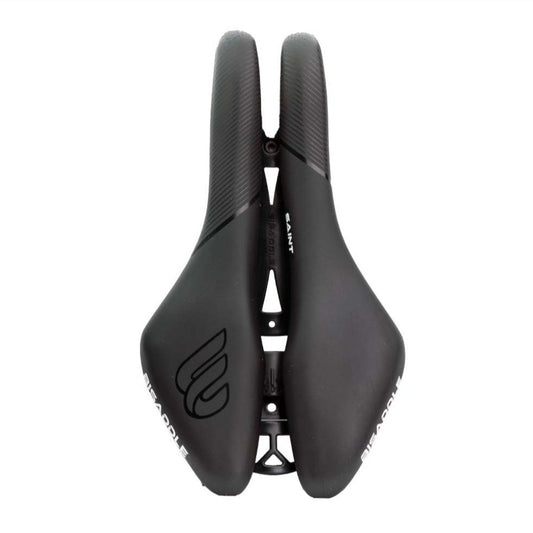
This is where adjustable saddles like BiSaddle represent a fundamentally different approach.
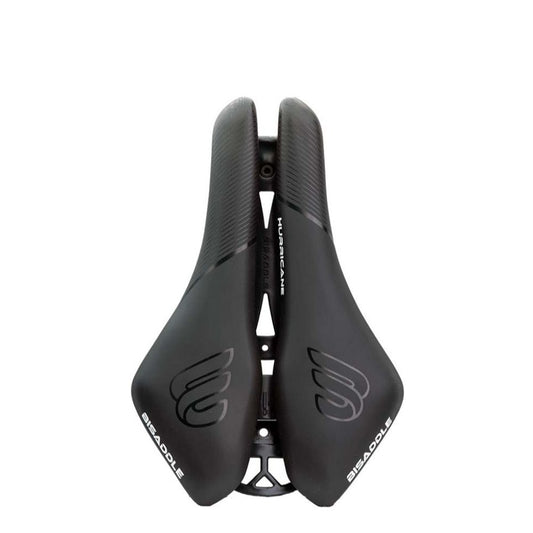
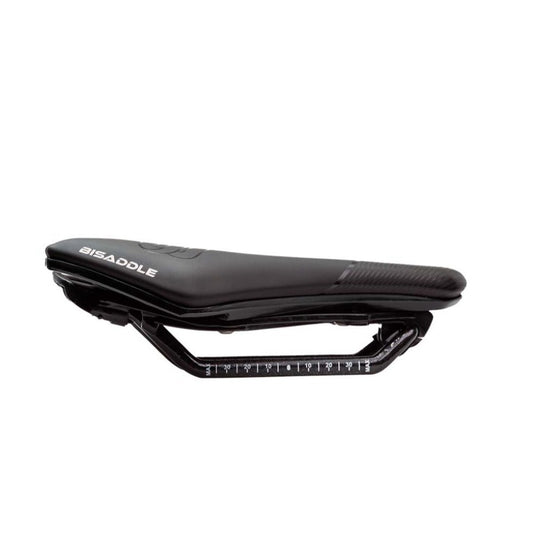
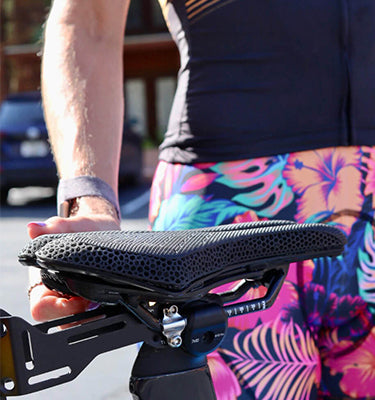
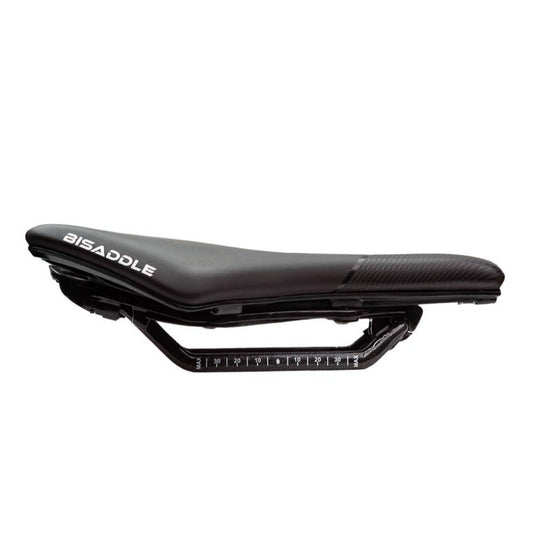
The BiSaddle features two independent halves that slide and pivot, allowing width adjustment from approximately 100mm to 175mm and variable profile curvature. From an engineering perspective, this accomplishes several things simultaneously:
Dynamic Pressure Relief
By widening the rear section to precisely match your sit bone spacing, your ischial tuberosities bear weight as intended. When the halves separate, a customizable central gap forms—essentially a cut-out that you can narrow or widen to match your anatomy.
Position Versatility
You can configure the same saddle for different riding scenarios. Narrower for aggressive road racing, wider for endurance comfort, or with a minimal front section for triathlon-style pelvic rotation. This isn't just convenience—it's biomechanically sophisticated.
Iterative Optimization
Unlike the expensive trial-and-error process of buying and testing numerous saddles, an adjustable design enables systematic refinement. Experiencing numbness? Widen the gap. Sit bone soreness? Adjust the width or tilt. This transforms saddle fitting from guesswork into a methodical process.
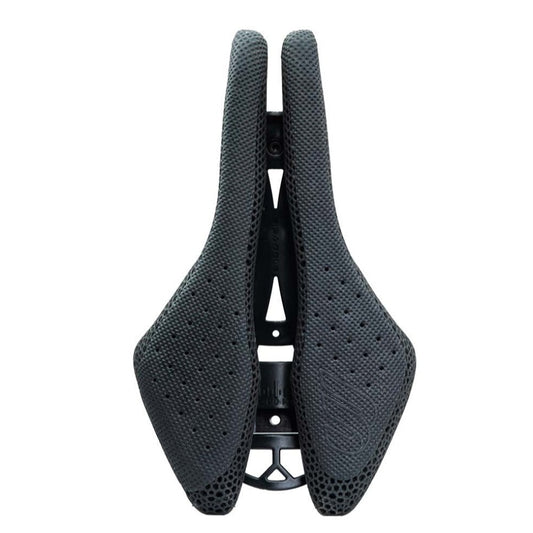
BiSaddle's approach also incorporates modern material innovations, with models featuring 3D-printed lattice padding—marrying the personalization of shape with the pressure distribution advantages of engineered cushioning structures.
3D Printing: The Material Science Revolution
Speaking of 3D-printed padding, this represents more than incremental improvement—it's a genuinely new capability in saddle design.
Traditional foam padding is essentially homogeneous. You can vary thickness and use different density layers, but within a given piece, the properties are uniform. This creates inherent compromises: the padding that cushions your sit bones ideally is different from what should exist (or not exist) under your perineum.
Additive manufacturing eliminates this constraint entirely.
Companies like Specialized, Fizik, and Selle Italia now produce saddles with continuously variable lattice structures—dense and supportive under the sit bones, progressively softer toward the edges, and essentially absent in the central relief channel.
Specialized's Mirror technology, for instance, uses a 3D-printed TPU (thermoplastic polyurethane) matrix that riders describe as having a “hammock-like” quality. The structure deforms under load but rebounds immediately, providing dynamic cushioning that responds to pressure variations during each pedal stroke.
These lattice structures are mostly air, which provides two additional benefits:
- Superior breathability—reducing heat and moisture buildup that contributes to saddle sores
- Three-dimensional compliance—the lattice can compress vertically under sit bone pressure while remaining stiff laterally to prevent pressure concentration from excessive deformation
It's engineering that would be literally impossible with traditional manufacturing methods.
The Dangerous Myth of “Breaking In”
Let's address something that needs to be said plainly: the advice that saddles require a “break-in period” or that some discomfort is normal initially is frequently harmful.
This advice is occasionally valid for leather saddles that genuinely mold to the rider over time. But for modern saddles with synthetic covers and foam or lattice padding, “breaking in” usually means “your tissue is adapting to chronic trauma.”
Here's what actually happens:
Saddle sores begin as friction-induced irritation—essentially road rash in the perineal region. When a poorly fitted saddle creates pressure points, these irritated areas experience reduced blood flow, which impairs healing and creates perfect conditions for bacterial infection in compromised tissue. What starts as superficial chafing can progress to subcutaneous abscesses or deeper tissue damage.
The medical term for one such condition is Alcock's syndrome—pudendal nerve entrapment that results in persistent perineal pain and numbness even when not riding. This isn't a temporary annoyance; it's a repetitive stress injury equivalent to carpal tunnel syndrome, but affecting nerves critical for sexual and urological function.
The concerning aspect is how normalized this has become. Cycling forums are filled with discussions of managing saddle sores as an inevitable aspect of the sport, complete with recommendations for chamois creams, antibacterial ointments, and time-off-the-bike protocols.
It would be like distance runners accepting that shin splints are just part of running, rather than recognizing them as indicators of inappropriate footwear or biomechanics.
If your saddle is causing tissue damage, the saddle is wrong—not your body.
The Fitting Gap: Why Smart Purchases Still Fail
Despite all these advances in saddle technology, many cyclists still end up on inappropriate saddles. The core problem is the disconnect between how saddles are purchased and how fit should actually be determined.
Walk into most bike shops and you'll find saddles selected primarily by price point, brand affiliation, and aesthetic appeal. Some shops offer sit bone measurement—typically having you sit on a gel pad to create an impression, then measuring the distance between pressure points.
This is helpful, but woefully incomplete.
Sit bone spacing is just one variable. Pelvic rotation (which varies with flexibility and riding style), soft tissue anatomy, riding duration, typical positions, prior injuries, and even your core strength all influence what saddle configuration will prevent perineal pressure.
The sophisticated fitting systems—Specialized's Body Geometry, Selle Italia's idmatch, gebioMized pressure mapping—provide comprehensive assessment. But they require specialized equipment and trained fitters, making them inaccessible to most cyclists and often costing $200-300 for the service alone.
This is where adjustable saddles offer compelling value. Rather than requiring professional fitting to identify the correct fixed saddle from hundreds of options, an adjustable design enables you to methodically optimize your own fit. It democratizes the fitting process.