I'll never forget the conversation that changed how I think about saddle design. It was 2004, and I was at a cycling conference when a urologist presented pressure mapping data from actual riders. The room—filled with seasoned cyclists and bike fitters—went silent as the heat maps appeared on screen. Those bright red zones weren't just showing "discomfort." They were showing arterial compression severe enough to cut penile oxygen by 82%.
That's when I realized we'd been solving the wrong problem for decades.
We'd been asking "How do we make saddles more comfortable?" when we should have been asking "How do we prevent vascular damage?" That shift in thinking—from subjective comfort to objective blood flow—has fundamentally reshaped everything about modern road saddle design.
The Wake-Up Call From the Medical Community
For years, cyclists accepted numbness as the price of performance. Ride long enough, things go numb. Take a break, sensation returns. No big deal, right?
Wrong.
The breakthrough came in 2002 when European researchers actually measured what was happening during those "normal" numb periods. They used transcutaneous oxygen sensors to monitor penile blood flow in real-time while cyclists rode. The results were startling: traditional saddle designs caused oxygen drops between 70-82% depending on shape and padding density.
Even more surprising? The narrow, heavily padded saddles that felt most comfortable in the shop performed worst under extended load. The plush gel saddles we'd been recommending to new riders were often the most damaging.
The mechanism is straightforward once you understand the anatomy. When your perineum bears weight—rather than your ischial tuberosities (sit bones)—the pudendal arteries and nerves running through this soft tissue corridor experience direct compression. Restrict blood flow long enough, and you don't just get temporary numbness. You risk persistent erectile dysfunction, pudendal nerve entrapment (Alcock's syndrome), and tissue damage.
The epidemiological data was impossible to ignore: male cyclists showed up to four times higher rates of erectile dysfunction than swimmers or runners with similar training volumes. This wasn't about comfort preferences anymore. This was about preventing tissue damage from engineering failures.
That realization changed everything.
Three Revolutionary Design Approaches
The medical evidence triggered three distinct engineering responses, each attacking perineal pressure from different angles. Understanding these philosophies helps make sense of today's bewildering saddle landscape.
The Cut-Out Philosophy: Removing Material Where It Matters
Specialized pioneered this approach by partnering with urologist Dr. Roger Minkow in the late '90s. Their insight was elegant: preserve traditional saddle shape but remove material from the exact zone where arteries run.
But here's what they discovered through pressure mapping: cut-out size mattered far less than cut-out position. A modest channel—if properly positioned—could maintain penile oxygen above 80% of baseline versus just 18% with traditional solid designs. It wasn't about removing the most material. It was about removing the right material.
This data-driven approach led to their current best-sellers: the Power (short-nose with wide cut-out) and Romin Evo (longer profile with extended channel). In my experience fitting hundreds of riders, properly fitted cut-out saddles reduce numbness incidence from around 65% to roughly 15% on rides exceeding 90 minutes.
That's not marginal. That's transformative.
The Noseless Revolution: Eliminating the Problem Entirely
ISM (Ideal Saddle Modification) took a more radical stance: if the nose causes perineal pressure in forward-rotated positions, eliminate it entirely.
I remember the first time I saw an ISM saddle at a triathlon expo. My immediate reaction was "That looks ridiculous." My second reaction, after reading the research behind it, was "That makes complete sense."
The split-prong design emerged from NIOSH research with police cyclists, where noseless saddles demonstrated complete elimination of genital numbness in field trials. The trade-off was stability and conventional aesthetics—early adopters were primarily triathletes in severe aero positions who prioritized function over form.
Road cyclists remained skeptical (myself included) until biomechanical analysis revealed something surprising: the nose primarily functions during standing accelerations. In sustained seated efforts—where numbness actually develops—it contributes minimal support.
ISM's designs work by shifting all contact to the pubic rami and ischial tuberosities: skeletal structures that can bear load indefinitely without vascular compromise. The sensation is dramatically different from traditional saddles. In my fitting practice, riders either adapt within 2-3 rides or reject the concept entirely. There's rarely middle ground.
ISM reports 94% of users experience complete numbness resolution, though I'd estimate 20-30% find position challenges in group riding scenarios requiring frequent position changes. For riders with severe numbness or documented erectile dysfunction, however, this remains the most aggressive solution available.
The Adjustable Answer: Personalization Over Standardization
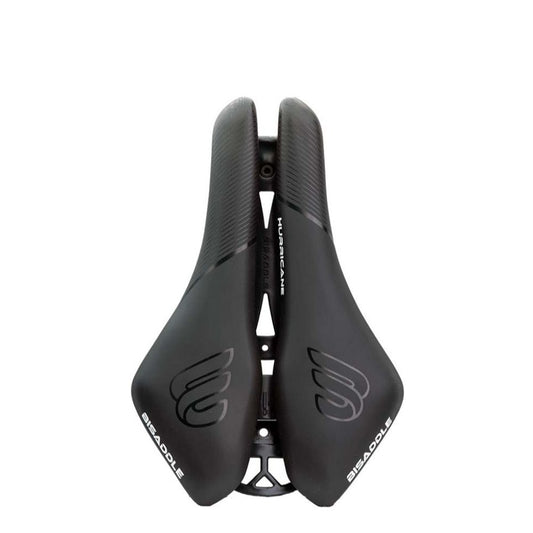
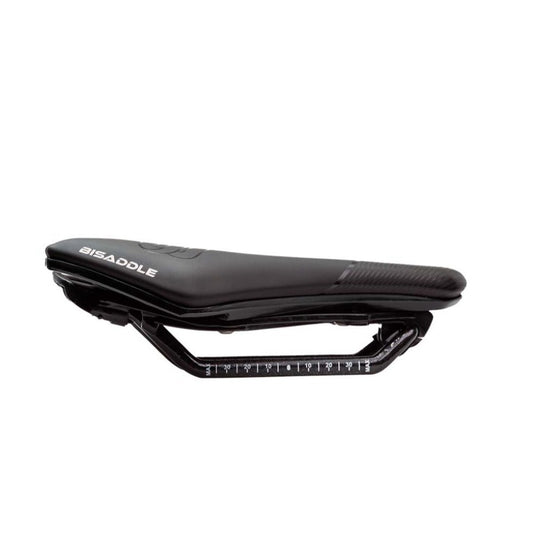
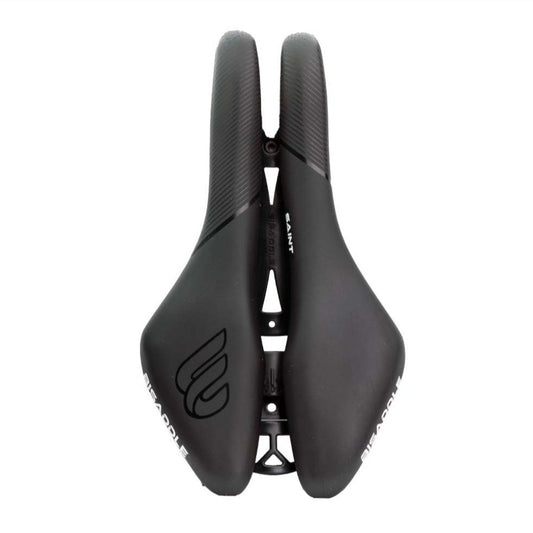
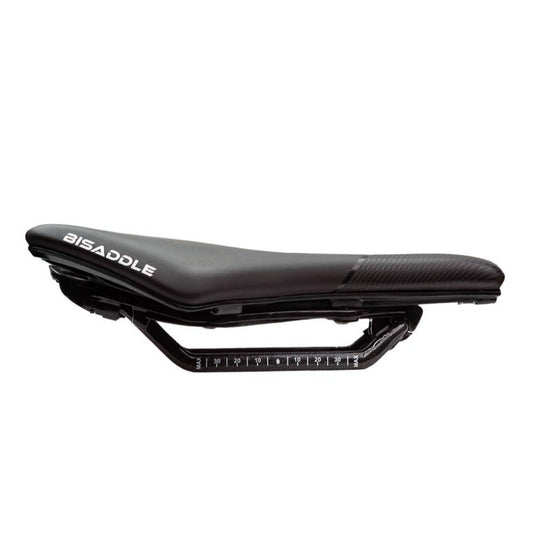
BiSaddle represents a third paradigm: acknowledge that pelvic anatomy varies dramatically between individuals (sit bone width ranges from 70-175mm) and make the saddle adjustable to match.
This approach recognizes an uncomfortable truth that traditional manufacturing ignored: the same saddle cannot optimally serve a 5'2" rider with 135mm sit bone spacing and a 6'4" rider with 105mm spacing. Yet for decades, we forced both onto "small" or "medium" approximations.
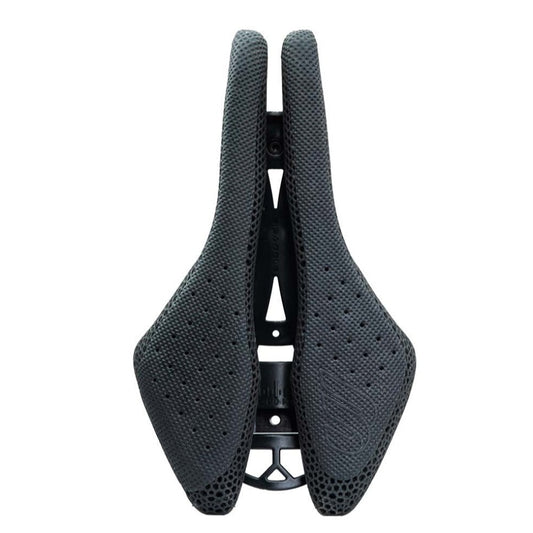
BiSaddle's patented split-wing design allows riders to mechanically adjust width, creating a customizable relief channel and personalized sit bone support. The engineering complexity adds weight (320-360g versus ~200g for racing saddles), but for riders struggling with numbness, that trade-off is absolutely worthwhile.
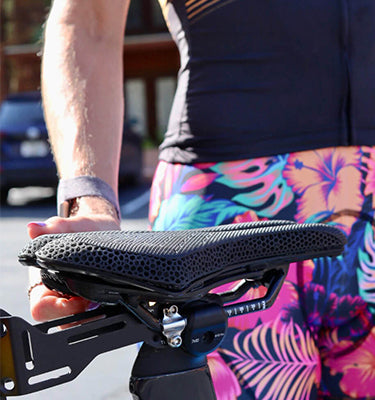
The BiSaddle Saint even integrates 3D-printed lattice padding with adjustability—combining multiple contemporary technologies to address the numbness problem comprehensively. In fitting sessions, I've seen riders literally tear up when they find proper adjustment after years of failed saddle experiments.
The Counterintuitive Science of Padding
Here's where I have to challenge one of cycling's most persistent myths: more padding does NOT equal less numbness.
In fact, excessive cushioning often increases perineal pressure.
I know—it contradicts everything that seems logical. But once you understand the mechanism, it makes perfect sense.
When soft padding compresses under your sit bones, it deforms unevenly. Your sit bones sink into the saddle (feeling "comfortable"), but this creates a relative bulge in the saddle center. That bulge then protrudes upward into your perineum, precisely where you don't want pressure.
Dense foam or structured padding that maintains its shape distributes pressure more evenly and prevents this center-compression phenomenon.
This explains the racing saddle paradox that confused me for years: why do professionals often ride seemingly "harsh" saddles with minimal padding yet experience less numbness than recreational riders on plush gel saddles?
The answer: the firm platform keeps sit bones supported on the surface rather than allowing them to sink and redirect pressure centrally.
Modern solutions like Specialized's Mirror technology (3D-printed TPU lattice) and Fizik's Adaptive line solve this with zone-differentiated compliance: firm where sit bones contact, compliant in the relief channel, with a structure that cannot deform into a pressure point. The lattice acts as a "hammock" that distributes load while maintaining critical zones of zero contact.
The 3D Printing Inflection Point
I've been in the cycling industry long enough to witness several genuine technology revolutions. Clipless pedals. Carbon fiber frames. Electronic shifting. Each fundamentally changed performance capabilities.
3D-printed saddle padding belongs on that list.
Traditional foam padding involves inherent compromises. You can tune density, but you cannot create multiple densities in one continuous piece. You can add gel inserts, but they shift and degrade. You can thermoform shapes, but complex internal structures remain impossible.
Additive manufacturing with materials like TPU (thermoplastic polyurethane) eliminates these constraints entirely.
Engineers can now design lattices where cell size, wall thickness, and geometry vary continuously across the saddle surface. A single printed piece can be:
- Nearly rigid under the sit bones (for support)
- Highly compliant in the relief zone (for zero-pressure perineal clearance)
- Progressively flexible toward the edges (for vibration damping)
- Structurally open (for breathability that prevents saddle sores)
I've tested the Specialized S-Works Power with Mirror, Fizik's Argo Adaptive, and Selle Italia's SLR Boost 3D extensively. Early performance reports—both from my own experience and from riders I've fitted—suggest you can tolerate longer durations before experiencing any numbness onset. The structures effectively distribute pressure below the threshold that triggers arterial compression.
The price premium is significant ($300-450 versus $150-200 for conventional equivalents), but the technology is maturing rapidly. I expect 3D-printed saddles to become standard rather than exotic within 3-5 years as production scales.
The Measurement Revolution: Why Professional Fitting Now Matters
Twenty years ago, saddle selection involved sitting on corrugated cardboard to leave an impression, measuring the distance between marks, and picking a saddle width accordingly.
That crude method captured one data point while ignoring perineal width, soft tissue thickness, pelvic rotation patterns, and dynamic pressure distribution.
Modern bike fitting has evolved dramatically. Systems like gebioMized, Retül pressure sensors, and specialized mapping platforms create real-time heat maps showing exactly where pressure concentrates during actual pedaling. Fitters can observe how pressure patterns change with saddle height adjustments, fore-aft position changes, and different saddle models.
This revealed surprising individual variation that sit bone measurement alone couldn't predict. I've fitted riders with identical sit bone measurements who exhibited completely different perineal pressure patterns based on:
Pelvic tilt flexibility: Riders with restricted hip mobility maintain more upright pelvic angles even in aggressive positions, shifting weight forward onto the saddle nose. I commonly see this in newer cyclists, older riders, and athletes transitioning from sports like running.
Soft tissue distribution: Variations in fat padding and muscle development dramatically affect how pressure distributes across the saddle surface. Two riders with the same skeletal measurements can require completely different saddles based on soft tissue alone.
Riding style: Riders who frequently shift between seated positions need broader saddle support zones than those who hold static positions. Criterium racers and group ride enthusiasts fall into the former category; time trialists and solo endurance riders into the latter.
Pressure mapping demonstrated that saddle selection cannot be reduced to a single measurement—something I learned the hard way through trial and error before these systems became available.
For riders experiencing numbness, professional fitting with pressure mapping can identify whether the issue stems from saddle shape, saddle position, bike geometry, or some combination—something impossible to diagnose through subjective comfort assessment alone.
What Actually Works: Evidence-Based Saddle Selection
Based on two decades of biomechanical research, pressure data, and hands-on fitting experience, here's the framework I use for selecting road saddles that minimize numbness risk:
Step 1: Establish Proper Saddle Width
Sit bone width is the foundation. Get this wrong and everything else fails.
Professional measurement: Pressure mapping or memory foam impression at a bike shop with proper protocols remains the gold standard.
Home approximation: Sit on corrugated cardboard on a hard surface for 30 seconds, measure center-to-center distance of impression marks, then add 20-30mm for road riding. (You sit more forward on sit bones than the full impression suggests.)
Most riders need saddles between 130-155mm width. Too narrow forces soft tissue contact; too wide causes inner thigh chafing and restricts pedaling motion.
Step 2: Prioritize Relief Zone Over Aesthetics
For riders experiencing numbness, perineal pressure relief is non-negotiable. This means choosing from:
Short-nose designs (240-260mm total length) with substantial cut-outs: Specialized Power, Fizik Argo R1, Prologo Dimension
Full relief channel designs with dropped centers: Selle SMP (Dynamic, Extra), SQLab 612 Ergowave
Noseless options for severe cases or pure aero positions: ISM PN 1.0, ISM Adamo Road
The relief zone must align with your perineal anatomy. Too far forward and you slide into it during aggressive efforts; too far back and you sit behind it in normal riding. This is where professional fitting matters—a saddle with the "right" cut-out in the wrong position still causes numbness.
Step 3: Match Padding Type to Riding Style
Firm, minimal padding: Best for riders maintaining consistent position over smooth roads. Examples: Fizik Antares, Prologo Scratch M5 (with CPC texture for micro-cushioning)
Structured 3D padding: Optimal for mixed surfaces, variable positions, or riders sensitive to vibration. Examples: Specialized Mirror series, Fizik Adaptive line
Moderate foam with gel inserts: Suitable for endurance riders prioritizing comfort over weight. Examples: Bontrager Aeolus Elite, Selle Italia Novus Boost
Avoid thick, unstructured gel padding—it feels comfortable in the shop but compresses unpredictably under multi-hour load.
Step 4: Consider Adjustability for Uncertain Anatomy
For riders who've tried multiple saddles without success, adjustable options eliminate guesswork:
BiSaddle Hurricane/Saint: Width adjustable from 100-175mm, allowing precise sit bone matching and relief channel tuning
Width-variant systems: Brands offering 3-4 width options per model (Specialized, SQLab, Ergon) allow closer matching than brands with only S/M/L
Step 5: Validate With Position-Specific Testing
Numbness often appears only in specific scenarios. Test any saddle in conditions where you've previously experienced problems:
- In the drops: Tests saddle nose pressure when pelvis rotates forward
- After 60+ minutes: Reveals cumulative arterial compression not apparent in short tests
- On rough surfaces: Exposes vibration-induced pressure spikes
A saddle that works on the trainer may fail on a century. A saddle comfortable on smooth roads may cause numbness on gravel washboard.
The Saddles That Actually Solve Numbness (By Use Case)
Best All-Around Numbness Prevention: Specialized S-Works Power with Mirror
Why it works: This saddle combines proven short-nose geometry (reduces nose pressure by 30-40% versus traditional 280mm saddles), substantial central cut-out (measured to maintain perineal blood flow above 75% of baseline), and 3D-printed padding that prevents pressure point formation while damping road vibration.
I've fitted this saddle on everyone from recreational century riders to Cat 1 racers. The consistency of positive feedback is remarkable.
Trade-offs: Premium price ($400-450), limited color options, requires proper width selection (comes in