You can measure sit bones all day on a gel pad and get a number that feels precise. That number describes one position only: upright, weight on the two bumps at the bottom of your pelvis.
Aero bars change everything. Your pelvis rolls forward and the load shifts to the pubic rami, the flat bones at the front. No gel pad measurement captures that. If your saddle is shaped for the bones you no longer sit on, the pressure lands on soft tissue instead.
A 2023 study found nearly half of female cyclists reported long-term genital swelling or asymmetry. Padding cannot fix a mismatch in where the load lands. Bone support is the variable that matters.
What Bike Fits Keep Missing
For years, women's saddles started from a men's shape and got a shorter nose or a different cover. Width options were limited. The idea was that female anatomy differs by a fixed amount, so a fixed shape would work.
It doesn't. One survey found that 35% of female riders reported vulvar swelling. The injuries happen when the saddle presses into labial tissue and the pubic arch instead of carrying load on bone.
Then came thick foam. It felt soft in the shop and collapsed under body weight by mile 30. If the shell underneath is too narrow, the padding gives way and soft tissue takes over. The saddle looks plush. It just doesn't support you where you need it.
Short-nose and cut-out designs helped. They removed material where pressure hurts. But they still asked you to pick one fixed width and one fixed angle. Your anatomy moves. The saddle didn't.
Aero Position Changes the Contact Point
In aerobars, the contact point moves from the ischial tuberosities toward the inferior pubic rami. The pubic arch is wider and flatter than the sit bones. Its slope varies from one rider to the next.
A saddle width measured in an upright position now fails in two directions:
- Too wide, and the wings press into your inner thighs, forcing your knees outward.
- Too narrow, and the pubic rami hang off the edges while soft tissue underneath takes the full load.
The central cutout is positioned for the mold, not for you. If your anatomy sits even a few millimeters forward of that spot, you get no relief. Some riders slide back on the saddle, opening the hip angle and losing power. Others stay put and start losing sensation.
Women also have a wider subpubic angle and more exposed soft tissue at the front. Width alone won't fix that. The saddle has to place that width under the pubic rami at the correct angle. A fixed mold can't do that for everyone.
Let the Saddle Change Shape
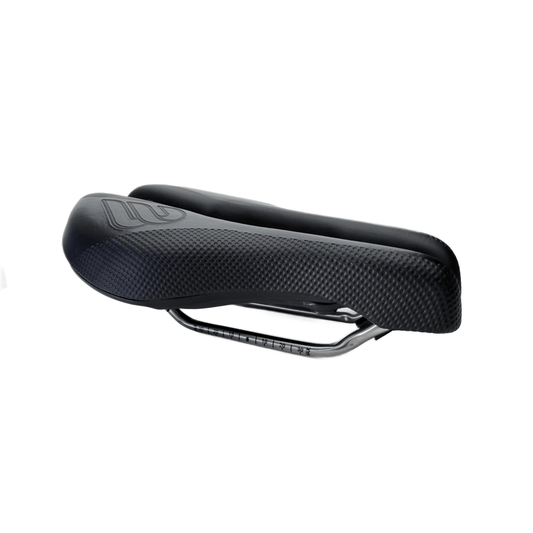
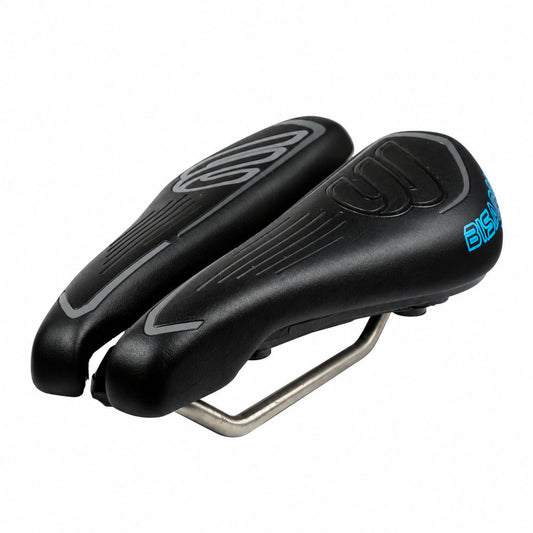
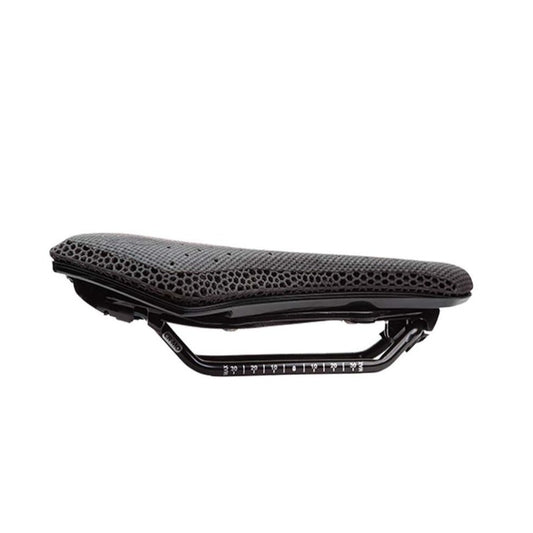
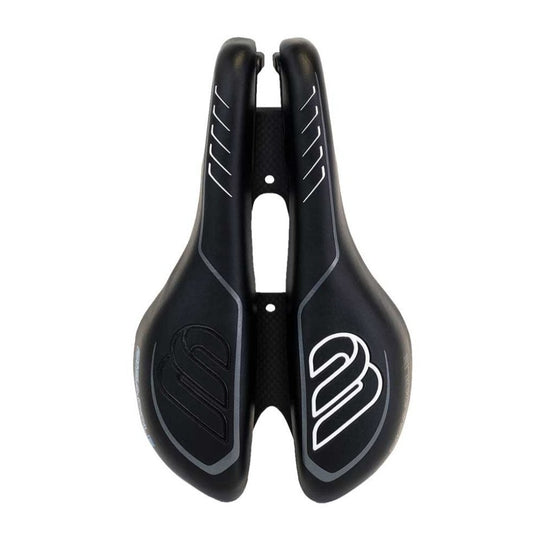
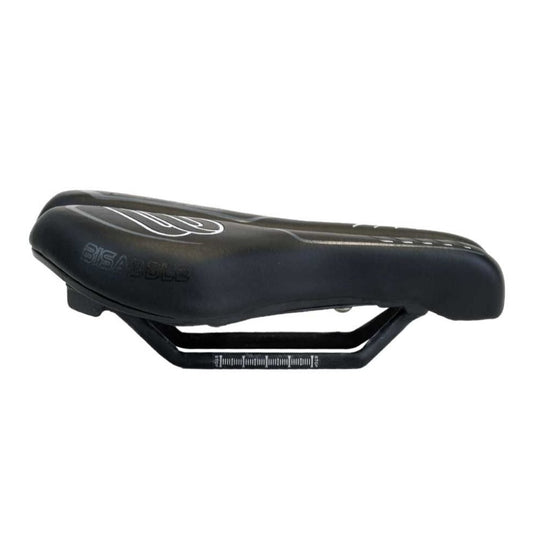
BiSaddle's design splits into two wings. Each wing slides independently on a rail. Rear width adjusts from 100 mm to 175 mm. Each wing also tilts to match the slope of your pubic rami.
As the wings move apart, the central gap widens. You get a pressure-free channel under the perineum without a one-size cutout. Set the wings narrow for an aggressive aero tuck. Widen them for long training rides on the hoods. For riders who want zero front contact, the BiSaddle SRT removes the nose entirely.
A common test case starts with a rider who measures 115 mm of sit bone spacing on a shop pad and buys a fixed 135 mm saddle. Upright, it feels fine. In aerobars, the load shifts forward, and the 135 mm width now creates two pressure points under the pubic rami. The central cutout doesn't align with her anatomy.
On a BiSaddle, she narrows the wings to 100 mm and angles the front edge down until the contact shifts back to bone. That takes a hex key and a few minutes. No second saddle. No guessing.
Adjustability also matters across a season. A rider gains hamstring flexibility over the winter and holds a lower aero position in spring. That changes the pelvic angle and moves the contact point again. With fixed wings, you buy a new saddle. With adjustable wings, you turn a bolt.
Bike fitters get the same benefit. One saddle can serve many riders, and the fitter can make a change mid-session and test it immediately. That shortens the trial-and-error loop.
Padding That Follows the Load Path
Adjustable hardware adds weight. Most BiSaddle models land between 300 and 360 grams depending on rails. That's a reasonable trade. The rider who buys this saddle is chasing power continuity, not grams.
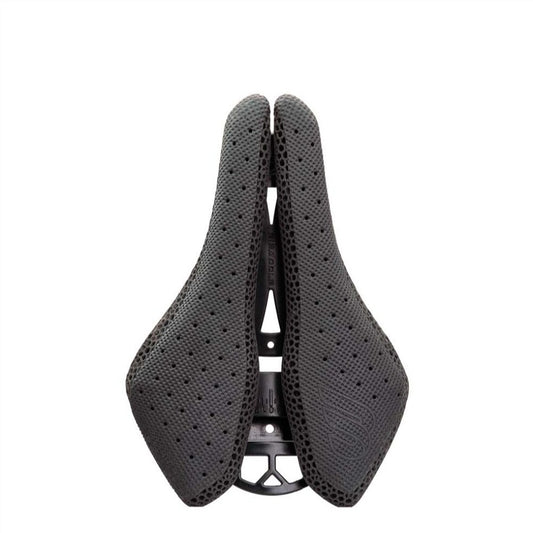
The BiSaddle Saint goes further with a 3D-printed lattice instead of solid foam. The lattice can be printed firmer in one zone and more open in another. Bone support can be firm. Soft tissue areas can stay open. A soft saddle under the sit bones deforms and pushes upward into tissue. A tuned lattice keeps bone on support and leaves soft tissue uncompressed.
The lattice also opens a future path. In a future version, BiSaddle could add pressure sensors to the lattice and send force distribution to a phone. You could see exactly where pressure crosses a threshold and tweak the wings in response. That is a natural extension of the adjustable-shape idea, and it would not require a full redesign.
Fit the Position You Ride In
The gel pad and ruler measure a posture that vanishes the second you drop to aerobars. Women triathletes need a saddle that changes when the load changes. BiSaddle lets you adjust rear width from 100 mm to 175 mm and angle each wing independently. The result is a mechanical match between the saddle and two bone structures that carry load differently. If the fit stops working at mile 40, you reach for a hex key, not your wallet.