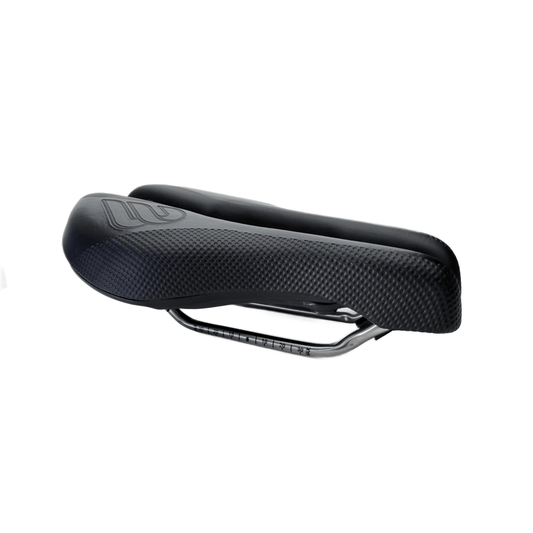
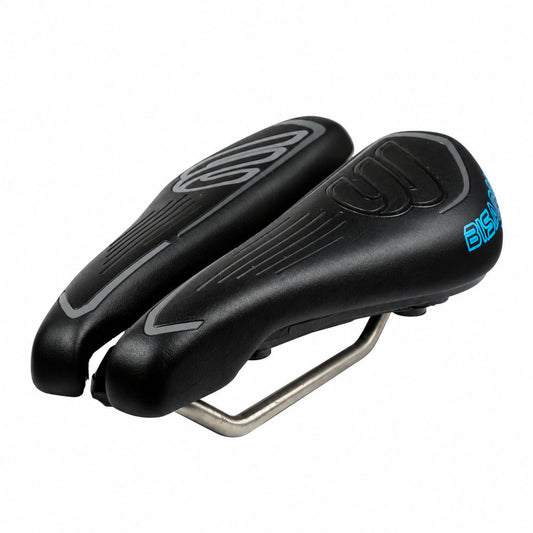
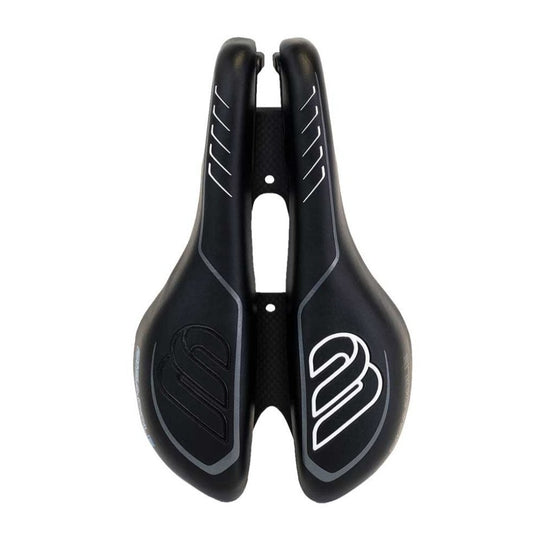
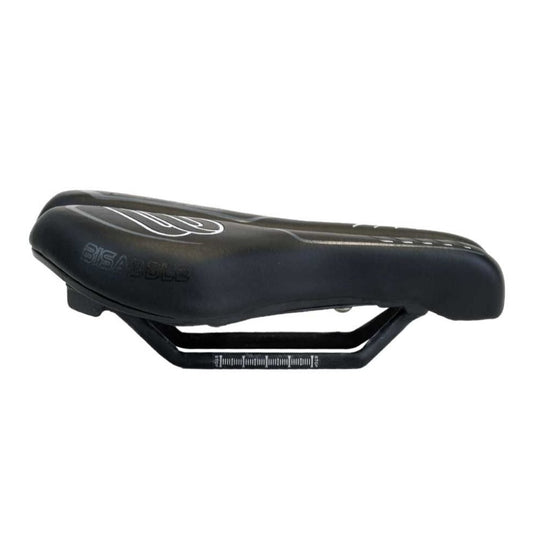
Nearly half the women in a 2023 survey reported long-term genital swelling or asymmetry from saddle pressure. A few years earlier, 35 percent said they had dealt with vulvar swelling after riding. These numbers hold steady even though the standard fit advice for women is to tilt the saddle nose down a few degrees. Tilt gets treated as the first adjustment because on a one-piece saddle it is the only way to lift the nose away from soft tissue. So riders start there. The order is backwards on a BiSaddle.
BiSaddle lets you set width, front gap, and each half's angle separately. You support your sit bones first. You clear your soft tissue with an adjustable central channel. Only then do you fine-tune tilt. The result is a fit that needs less tilt in the first place.
Why Tilting the Nose Down Hides the Real Problem
A saddle that is too narrow does not support the ischial tuberosities. The sit bones sit on the edges or hang over the sides, and weight shifts to the perineum and labia. When a rider feels pressure at the front, the usual suggestion is two or three degrees of nose-down tilt.
That lowers the front but also raises the rear. The rider slides forward. The sit bones lose contact with the wings, and hand pressure climbs. The soft tissue pressure usually comes back within minutes because the pelvis has shifted to a different spot.
For women, this sequence does real damage. A narrow or long nose compresses the vulvar tissue and pubic arch. Tilting the nose down might move contact from the labia to the clitoral area or pubic bone, but it does not remove contact. One survey found 35 percent of female riders had vulvar swelling after riding. A level saddle was not the problem. The saddle was too narrow, and the nose sat where your anatomy needs clearance.
BiSaddle changes this. The two halves slide apart from 100mm to 175mm. Your sit bones rest on dedicated wings instead of the edges. The central gap widens as the halves separate, creating an open channel for soft tissue. You can narrow the front section on its own, which shortens the nose without tilting the whole saddle. You create clearance without rotating the rear wings out of level.
Half-by-Half Tilt Is a Different Tool
A one-piece saddle has one angle for the entire platform. Angling the nose down rotates both the front and the rear. On a BiSaddle, each half pivots independently. The rear wing can stay level to support your sit bone while the front half angles down a degree or two to match anterior pelvic rotation. That separation is the mechanical difference.
Many women ride with pelvic asymmetry or a leg length difference that loads one side more than the other. With independent half tilt, you can set the left half at a slightly different angle than the right. A one-piece saddle cannot do this because the adjustment travels through the whole platform. On a BiSaddle, the left and right halves move on separate rails, so the correction stays local.
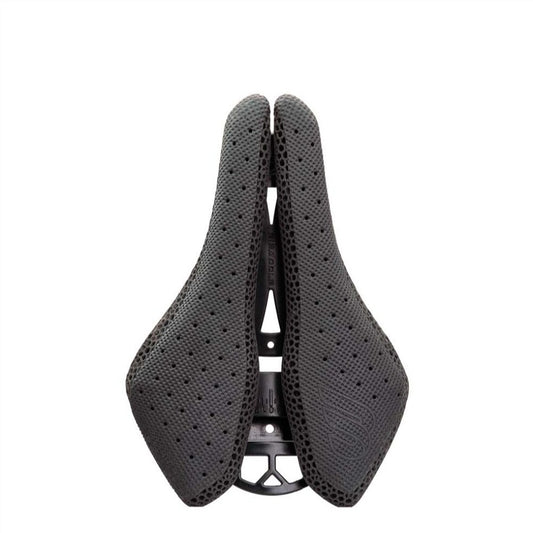
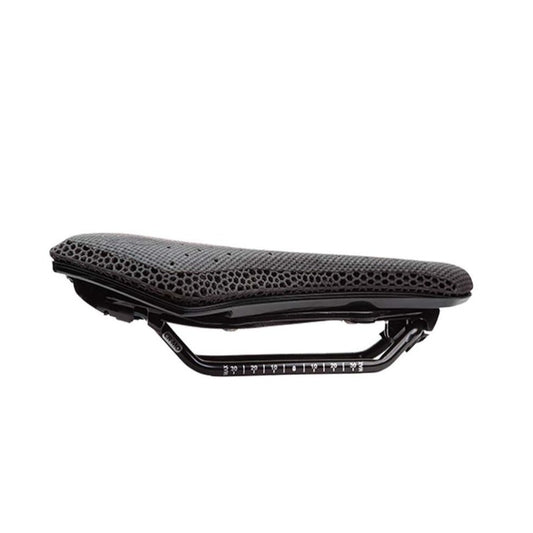
The Saint model adds a 3D-printed foam lattice over the adjustable shell. The lattice provides tuned cushioning that moves with the halves. New width and tilt settings do not create hard edges. As the halves separate, the central gap widens from a few millimeters into a true relief channel. The width of that channel follows your sit bone spacing, not a fixed cutout size.
The Fit Sequence That Puts Tilt Last
This sequence assumes the saddle is mounted and roughly centered on the rails.
- Set saddle height and fore-aft before touching width or tilt. Height and fore-aft determine where your sit bones land. Use your normal fit method, whether that is a dynamic fit or a home measurement of knee angle.
- Measure sit bone width. Sit on corrugated cardboard on a flat stool, lean forward into your riding position, and mark the two deepest impressions. Measure center to center. Add 15 to 20 millimeters for a road position and closer to 25 for an upright or gravel position. That total is your starting rear width.
- Slide the BiSaddle halves apart to that width and lock them down. The rear wings should sit directly under the ischial tuberosities. If you are between two widths, start wider. You can narrow later.
- Set the front gap. Narrow the front section or widen the central channel until your soft tissue has clearance during a normal pedal stroke. The goal is no contact between the labia and the saddle surface in your typical riding posture. If you need maximum clearance, BiSaddle offers a fully noseless variant, the SRT.
- Now adjust tilt. Start with both halves level front to rear. Ride for 15 minutes in your most common position, whether that is on the hoods, in the drops, or on aero bars. Note where pressure appears. If you feel pressure at the front, angle only the front half down one degree at a time. If you slide forward, angle the rear half up slightly or move the saddle back. Adjust left and right independently if one side carries more load.
By the time you touch tilt, the main sources of soft tissue pressure are gone. Width has moved load onto the sit bones. The front gap has removed the nose as a contact point. Tilt only needs to match your pelvic rotation now, a fine adjustment of one or two degrees, not a workaround for poor width.
What the Data Shows About Width Versus Tilt
A 2023 study of female cyclists found nearly 50 percent reported long-term genital swelling or asymmetry. The same research links those injuries to pressure on the labia and pubic region when a saddle fails to match pelvic anatomy. Narrow saddles are the usual culprit because they shift load from the sit bones to soft tissue.
Tilt cannot correct that load shift. If the sit bones are not on the wings, the body's weight still goes somewhere. Tilting the nose down may relieve the front for a moment, but it also rotates the rear up and reduces the surface area under the sit bones. The rider slides forward, and the cycle repeats. Tilt-first fit sessions often end with a saddle that is still uncomfortable and a rider who adjusts the angle before every ride.
BiSaddle attacks the root cause because width and front gap are set before angle. The independent wings support the sit bones at a width you choose, from 100mm to 175mm. The central gap opens as the halves separate, so soft tissue clearance matches your anatomy. Only after those two variables are set does the half-specific tilt become relevant.
A saddle that makes you slide forward also increases friction. Saddle sores begin as chafing, pressure, and moisture. If tilt-first fitting leaves you sliding, the skin at the contact points gets rubbed repeatedly. Setting width first keeps you stable, so tilt does not have to compensate and friction stays lower.
Road, Triathlon, and Gravel: How Tilt Last Plays Out
In a road endurance position, you spend hours in a moderately forward lean. A level rear wing gives stable sit bone support, while a slight downward front angle can match the forward pelvic rotation. Because BiSaddle width is adjustable, you can set the rear wider for long rides without losing the narrow front that reduces thigh friction.
In a triathlon position, the pelvis rotates far forward and weight moves onto the pubic rami. A fixed saddle tilted down enough to relieve the perineum can make the rear useless. On a BiSaddle, keep the rear level or slightly tilted to carry sit bone weight, and angle only the front half down more aggressively. The adjustable central channel gives the soft tissue somewhere to go. That combination lets you hold an aero position without shifting.
On gravel, bumpy surfaces reward stability. A tilt-first setup that slides you forward on washboard will break down. Set the rear wings level and wide, keep the front gap generous, and use half tilt only for the front edge. You get the vibration-damping benefit of the 3D-printed Saint surface without sacrificing sit bone contact.
A Level Saddle Is Not the Enemy
The standard instruction for women is to start with the nose down a few degrees. That implies a level saddle causes soft tissue pain. On a one-piece saddle, that can be true because the nose occupies the space your anatomy needs.
On a BiSaddle, you can narrow or remove the nose, open the central channel, and set the rear to your sit bone width. With those factors corrected, many women find a level rear and a nearly level front feel right. Some need a slight downward front. Some need a slight upward front if they roll the pelvis back.
There is no single correct angle. Tilt is a small trim adjustment after width, gap, and fore-aft are set. That reorder is exactly what BiSaddle's independent adjustable halves allow.
If you have been tilting the nose down for years and still deal with numbness or saddle sores, reverse the sequence. Set the width first. Then open the front gap. Then touch tilt. The difference is not subtle.