Day four of a bikepacking trip is where many women hit a wall of saddle pain. The first couple days feel manageable. By the third or fourth morning, tissue swelling and pressure points have compounded. The saddle that felt fine on a short training ride now forces constant shifting. That shifting is not a willpower problem. It is a static fit problem.
A fixed saddle has one width, one length, one amount of cutout, one angle. Your riding position on a loaded bike changes hour to hour. Your sit bone distance and soft tissue tolerance change day to day as muscles fatigue and swelling develops. The solution is a saddle you can adjust mid-trip. BiSaddle builds a saddle with user-adjustable width and angle. This post explains the biomechanical case for adjustability and how to use it on multi-day rides.
From Leather Break-In to Mechanical Adjustment
Early leather saddles were not adjustable, but they did adapt. Riders spent weeks breaking in a leather top until it compressed and shaped to their sit bones. That process was slow, weather-sensitive, and required maintenance, but it produced a custom fit.
When molded foam and gel saddles took over, they removed the break-in chore but also removed adaptation. A foam saddle arrives in its final shape. If that shape does not match your anatomy, you buy another one. The cutout era added central pressure relief but still forced riders to choose from fixed widths and profiles. Women's-specific saddles addressed some anatomical differences, but they still commit you to one shape. BiSaddle represents the next step: mechanical adaptation instead of material break-in.
This history matters because bikepacking multiplies demands. A road rider can manage a fixed shape because the position stays relatively consistent. A bikepacker moves from seated climbs to standing descents to aero tucks on gravel, often for 8 to 12 hours a day across multiple days. The saddle must support several postures. Leather would eventually mold to one position. Fixed foam supports one compromise. Adjustable geometry can be changed as the position changes.
Why a Fixed Saddle Becomes a Compromise on Day Three
Women's anatomy creates specific pressure points. A 2023 survey of female cyclists found that nearly 50% had experienced long-term genital swelling or asymmetry, and 35% had experienced vulvar swelling. That data matches the mechanics. The pudendal nerve and labial tissue sit directly under the saddle's nose and central area. If a fixed saddle is slightly too narrow at the rear, the sit bones don't carry the load, so soft tissue takes it. If the nose is too long or too high, pressure lands on the labia and perineal region.
On a multi-day ride, the problem compounds. Day one may be fine. By day three, tissue inflammation lowers your tolerance. You shift forward or back to relieve one spot, which overloads another. Saddle sores develop where friction and pressure concentrate. A static saddle cannot respond. You can only change shorts, chamois cream, or position. The saddle itself remains the same.
Bikepacking also changes your fit through the trip. You ride a loaded bike, often with a more upright position because of handlebar bags or fatigue. That upright posture rotates the pelvis backward, widening the effective sit bone contact and shifting weight onto the rear of the saddle. A saddle set up for an aggressive road position may now press the nose upward into soft tissue. A saddle set up for upright riding may be too wide when you drop into a tuck on a fast gravel descent. Your fit requirement changes as the trip moves. A saddle that adapts can follow.
The Adjustable Baseline: BiSaddle's Geometry
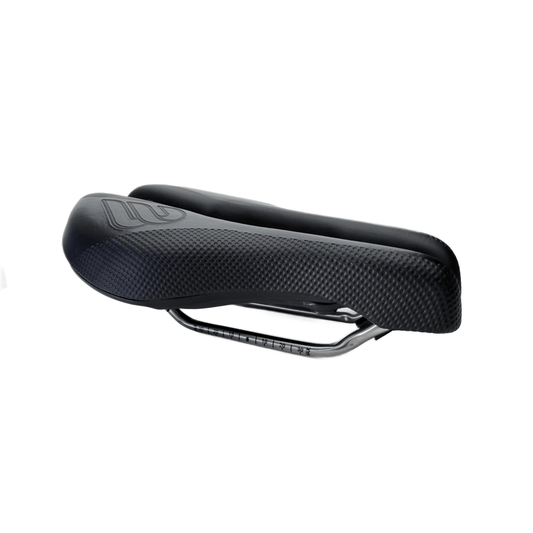
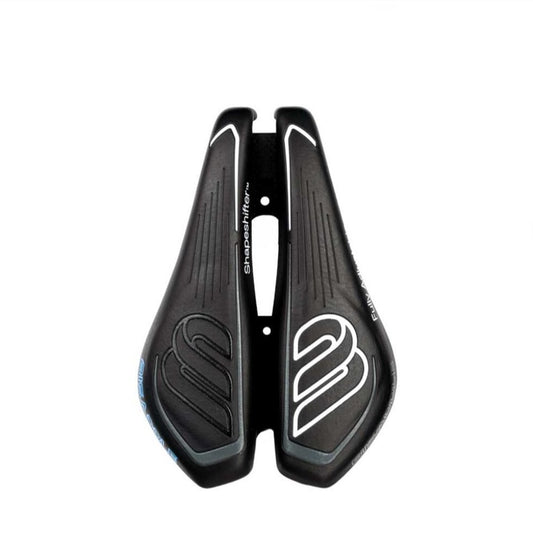
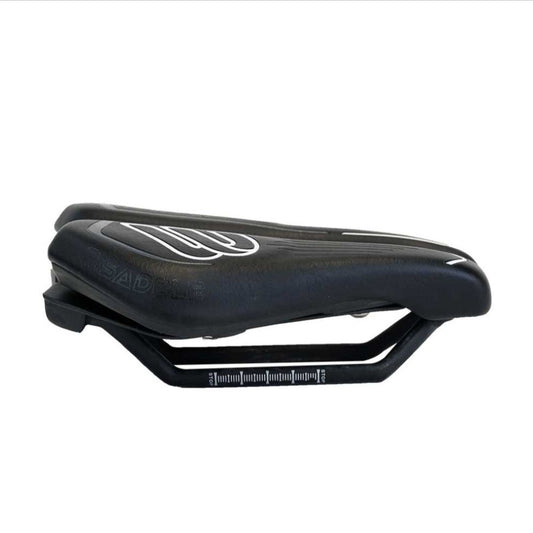
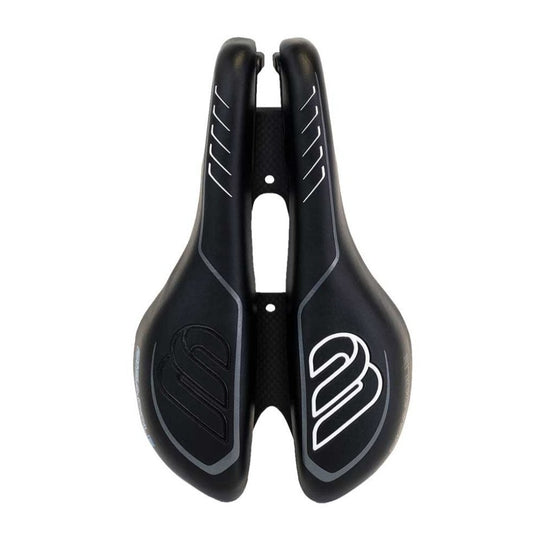
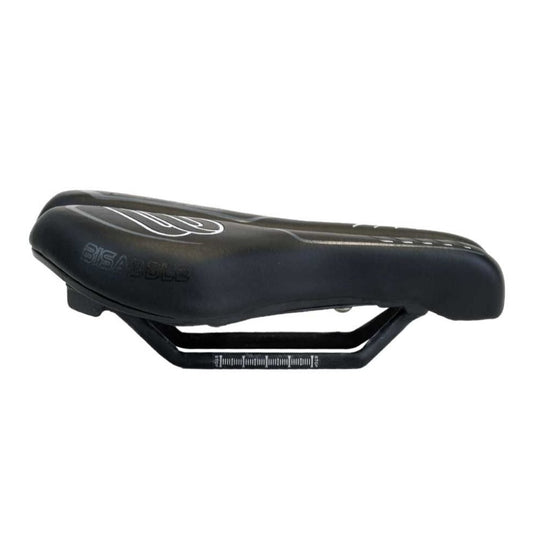
BiSaddle's saddle consists of two independent halves that slide and pivot on rails. The rear width adjusts from 100mm to 175mm. Each half can also be angled independently to change the top profile. This means you can set the rear wide enough to support your sit bones, narrow the front to reduce nose pressure, and tilt each wing to follow your anatomy. A central gap opens between the halves when they move apart, creating an adjustable pressure relief channel. The saddle is 240mm long, and a noseless variant removes the front entirely for riders who want zero nose contact.
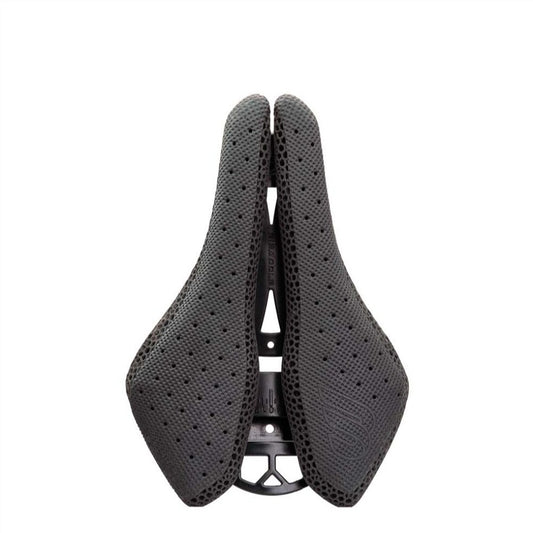
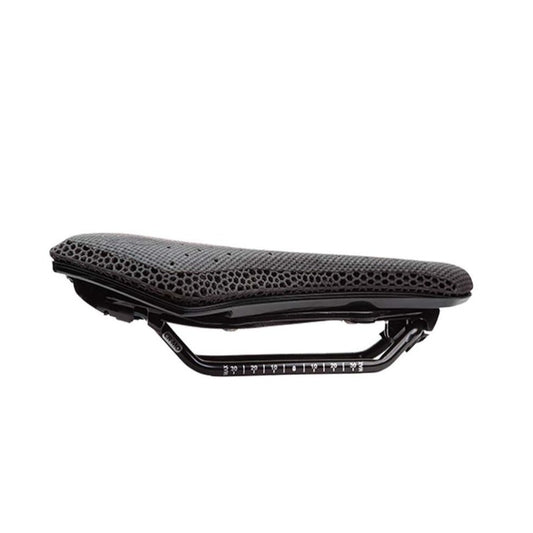
The Saint model adds a 3D-printed polymer foam surface on top of the adjustable base. That lattice structure provides tuned cushioning without the bottoming-out problem of thick gel. Weight ranges from about 360g with chromoly rails to about 320g with carbon rails. Price sits between $249 and $349 depending on the model and rail material.
Setting Up a BiSaddle for a Loaded Multi-Day Ride
Before your first loaded ride, follow these steps:
- Measure your sit bones at home with corrugated cardboard or a memory foam pad. Sit for a few minutes, then measure center to center between the depressions. Add 20 to 30mm to that number for your starting rear width on the BiSaddle.
- Set the rear width to that starting point, narrow the front halves slightly, and keep the top level. Ride loaded, because bike luggage changes your weight distribution.
- Pay attention to pressure. If your sit bones feel like they are hanging off the edges, widen the rear by 5mm. If you feel pinching in the middle, open the central gap another few millimeters. If the nose presses into soft tissue, angle the front halves downward slightly or move them closer together.
- After the first long day, expect some tissue swelling. That is normal. Before day two, check the saddle again. Many riders need a slightly wider rear or a more open central gap on day three than on day one because swelling and fatigue have changed the contact area.
- For bikepacking, set the rear slightly wider than you would for a fast road ride. Loaded bikepacking tends toward a more upright posture, which increases sit bone load. A wider rear gives those bones a stable platform. If you know you'll be doing fast gravel sections, narrow the front and drop the nose slightly to allow a lower position without pressure. The same saddle can serve both configurations.
These adjustments take a few minutes with the included tool.
- Sit bone ache by day three: Fixed saddle cannot change width. BiSaddle response: widen the rear by 5mm.
- Labial swelling or numbness: Fixed saddle nose pressure cannot move. BiSaddle response: narrow front halves or angle the wings downward.
- Inner thigh chafing and saddle sore: Fixed saddle front width stays fixed. BiSaddle response: bring front halves closer together.
- Central soft tissue pressure: Fixed saddle cutout is fixed or absent. BiSaddle response: increase the central gap between halves.
- Upright loaded posture needs more rear support: Fixed saddle has a single rear width. BiSaddle response: widen rear to match loaded sit position.
What the Research Says About Soft Tissue Pressure
Saddle pressure research consistently points to the same principle: support the bony structures, relieve the soft tissue. A 2002 study measured penile oxygen pressure on different saddle types. A conventional narrow saddle caused an 82% drop in penile oxygen pressure. A wider noseless design limited the drop to about 20%. The mechanism is arterial compression. When the saddle presses on the perineal arteries, blood flow drops.
For women, the same anatomical logic applies to the pudendal nerve and labial tissue. A saddle too narrow at the rear shifts load to soft tissue. A nose too long or too high presses directly on sensitive structures. BiSaddle's split design addresses this by allowing the rear to be set wide enough to carry weight on the ischial tuberosities. The central gap then removes material from the high-pressure zone between the sit bones.
The swelling and asymmetry rates from the 2023 survey make the mechanism concrete. Those injuries arise from prolonged pressure on the labia and pubic region. A saddle that can be widened at the rear and narrowed at the nose keeps the weight on the skeletal structure where it belongs, instead of soft tissue that cannot tolerate multi-day load.
Saddle sores also respond to adjustability. Sores begin as friction and pressure at specific contact points. If the saddle is too narrow, the sit bones slide off the support and rub. If the saddle is too wide at the nose, it chafes the inner thighs. By adjusting the width and angle, you can eliminate the specific pressure point that starts a sore. A fixed saddle cannot do that.
Trade-Offs: Weight, Price, and the One-Saddle Argument
BiSaddle is not the lightest saddle on the market. The adjustable hardware adds weight. Most models land between 320g and 360g. For a bikepacker, that difference is negligible compared to water, food, and bags. A 50g saving on a saddle disappears under a full frame bag. The adjustability is worth the grams if it prevents a saddle sore that costs you a day off the bike.
The price, $249 to $349, is also higher than many fixed foam saddles. But consider the alternative: buying and discarding several fixed saddles while searching for comfort. Many riders spend that amount across multiple failed purchases. A BiSaddle can also move between bikes. You can use the same saddle on a road bike, a gravel bike, and a touring bike by changing the width and angle.
The one-saddle argument matters for women who split time between disciplines. A triathlon position puts the pelvis rotated forward and loads the front of the saddle. A bikepacking position is more upright and loads the rear. A road position sits in between. With BiSaddle, you can open the front for triathlon, widen the rear for bikepacking, and set a middle position for road. You don't need three saddles.
A Speculative Look Forward
Adjustable saddles are likely to become more common as riders demand personalization. The 3D-printed lattice on the Saint model shows one direction: the base adjusts mechanically, and the top layer distributes pressure with tuned density. The next step could be pressure sensors embedded in the saddle that tell you exactly which adjustment to make. A rider could see a real-time pressure map on a phone app and adjust the width by 2mm to relieve a hotspot. That technology would turn saddle fit from a one-time shop visit into an ongoing, data-informed process.
For bikepacking, the speculative future is straightforward. Riders start a trip with a baseline fit, then adjust each morning based on how tissue feels. A saddle that can adapt to swelling, fatigue, and changing posture reduces the number of trips ended early by saddle pain. The mechanical adjustability BiSaddle offers today is the foundation for that future. It does not require a bike fitter, a scanner, or a new saddle. It requires a hex key and five minutes.
The historical pattern points the same direction. Leather break-in gave way to foam, then cutouts, then women's-specific shapes. Each step added comfort but still forced the rider to adapt to the saddle. Adjustable geometry reverses that. The rider sets the saddle to the body.
Day four is where fixed saddles fail. Measuring, adjusting, and re-tuning reduces that failure. BiSaddle's adjustable width and angle give you that control. Set the rear to support your sit bones, open the central gap to relieve soft tissue, and re-check after each long day. A wider static back still cannot follow the drift of a multi-day ride. An adjustable saddle can.