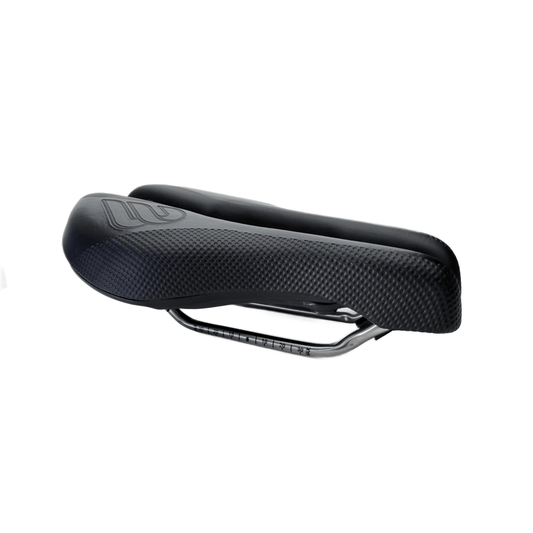
You lower the nose a degree, maybe two, and hope the numbness goes away. That's the standard saddle tilt advice for women. It treats the saddle as one rigid piece and assumes your pelvis is perfectly balanced left to right. For a lot of riders, that assumption falls apart within the first hour.
A 2023 survey of female cyclists found that 35 percent had experienced vulvar swelling. Nearly half reported long-term swelling or asymmetry. These aren't rare complaints. They're the predictable result of a saddle carrying your weight on soft tissue instead of bone.
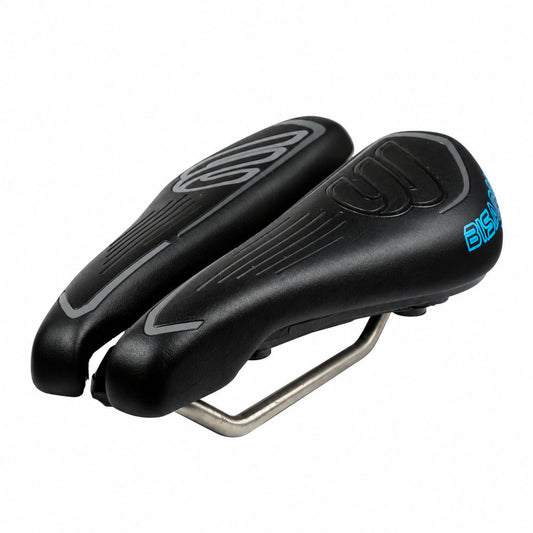
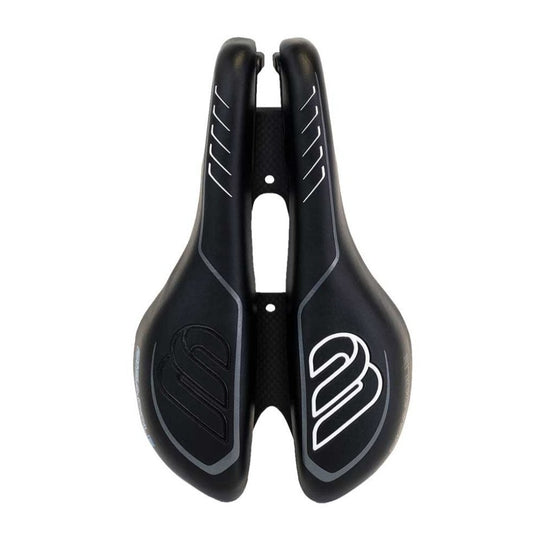
Bisaddle approaches the problem from a different angle. Instead of tweaking one global tilt and hoping, the saddle splits into two independently adjustable halves. That single change opens up a fix that fixed-shell saddles can't offer.
Your Pelvis Is Not a Flat Surface
Women generally have wider sit bones and a broader pubic arch than men. When you rotate your pelvis forward into an aggressive riding position, the load shifts from those sit bones to the pubic rami. The labia and the perineal branches of the pudendal nerve sit right in that load path.
Now think about what a global tilt actually does. It moves the entire saddle nose down or up. It cannot account for a left hip that drops slightly on each pedal stroke, or a leg length difference, or even the way you sit asymmetrically after an old injury. If one side of your pelvis sits higher, a symmetric saddle leaves that side unsupported. You shift your weight to the other side, develop a compensation pattern, and end up with one-sided numbness or chafing.
Bisaddle lets you set each half independently. A rider whose left hip drops can lower the left half by one degree while keeping the right half level. That moves pressure from the left labia to the left sit bone without sacrificing support on the right. No single-piece saddle can do that, because the whole surface moves together.
The Problem with One Angle and Three Riding Positions
Riding on the tops keeps your pelvis fairly upright. Drop into the drops, and your pelvis rotates forward enough to change the load-bearing surface. The saddle needs to support bone in one position and remove pressure from soft tissue in another.
A nose-down tilt that relieves perineal pressure in the drops will likely make you slide forward when you sit up. A nose-up tilt that feels comfortable upright can press the nose into soft tissue as soon as you get low. Fixed-shell saddles force you to pick a compromise. That compromise usually means the saddle works well in one position and poorly everywhere else.
If you ride mixed terrain or switch between endurance efforts and aero positions, that compromise fails predictably. You end up adjusting your body to the saddle instead of the saddle to your body.
What Bisaddle Actually Changes
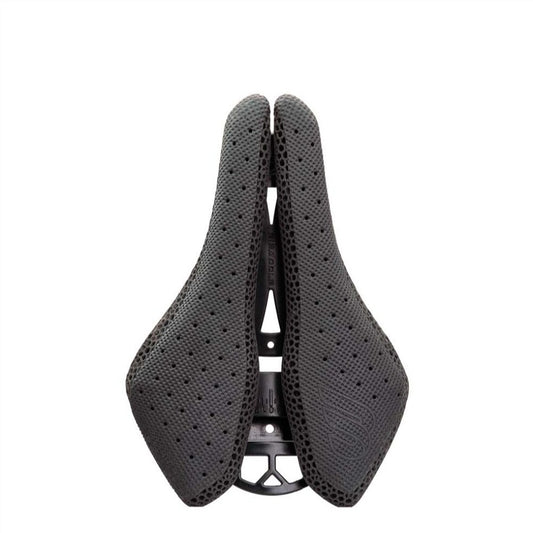
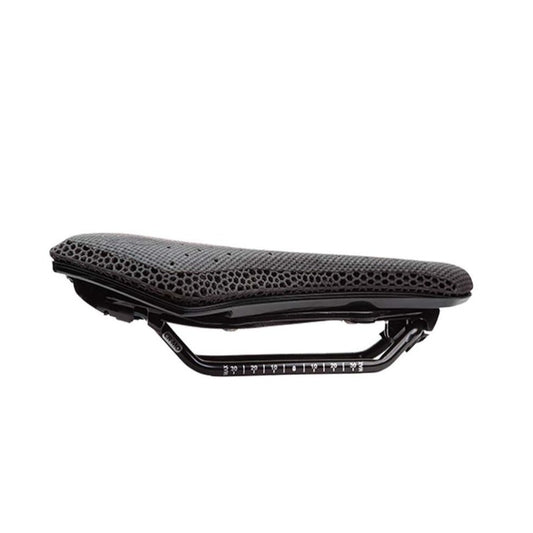
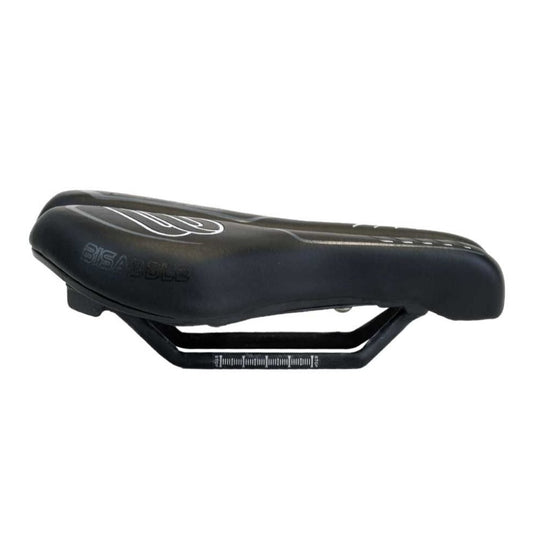
Bisaddle builds the saddle as two separate halves mounted on rails that slide and pivot. The rear width adjusts from about 100 mm to 175 mm to match your sit bone spacing. Each half can be angled independently. The gap between the halves creates a central relief channel whose width you control.
Bisaddle also offers the SRT, a noseless variant for riders who want to remove anterior pressure entirely. The Saint model pairs the adjustable halves with a 3D printed polymer lattice surface. That lattice deforms under your sit bones while staying firmer at the edges. For women, this combination tackles the two things a single tilt angle can't handle: left-right asymmetry and anterior soft tissue load.
The Blood Flow Numbers Behind the Design
In 2002, researchers measured penile oxygen pressure in cyclists sitting on different saddle designs. A narrow conventional saddle produced an 82 percent drop in penile oxygen. A wider noseless design limited the drop to about 20 percent. The researchers concluded that width and shape, not padding, determine whether blood flow stays intact.
The same mechanism applies to women. Compression of the pudendal nerve and artery causes numbness, labial swelling, and longer-term tissue changes. The 2023 survey results are the visible outcome of a saddle loading soft tissue instead of the ischial tuberosities and pubic rami. An adjustable central gap and independent half angle let you set each side to carry load on bone, not on the perineum.
Setting It Up Without Endless Trial and Error
Before you touch tilt, get saddle height right. An incorrect height changes how much weight your pubic rami carry and makes every tilt adjustment misleading. Once height is set, follow these steps.
- Set the two Bisaddle halves to your measured sit bone distance. If you don't have that measurement, start narrow and increase the width until pressure moves from soft tissue to the bones.
- Set both halves level and ride for 15 minutes in your most common position.
- If you feel pressure on one side of the labia or perineum, tilt that specific half down 1 degree and ride again.
- If you slide forward when sitting upright, tilt both halves up 1 degree together. Don't tilt just one side for that issue.
- Recheck after changing saddle height, reach, or cleat position. Pelvic rotation changes with each of those adjustments.
The Load Path Reframe
The load each saddle half carries depends on pelvic rotation, leg length difference, and riding position. A single global tilt ignores those variables. A two-half saddle with independent angle adjustment gives you control over width and side-specific tilt at the same time. That control is the variable a fixed shell cannot offer.
When each half carries your weight on the ischial tuberosities or pubic rami instead of the perineum, the tilt question resolves itself. You stop chasing a single perfect angle and start supporting your body where it actually needs support.