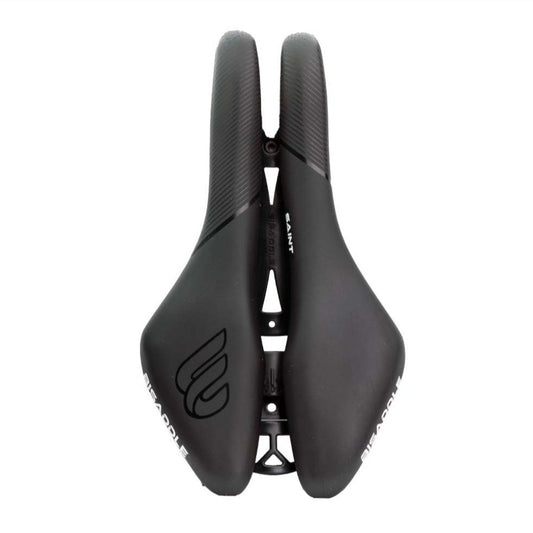
Have you ever wondered why some cyclists swear by those strange-looking saddles with the front chopped off? As someone who's spent decades designing, testing, and riding on virtually every saddle innovation, I'm going to take you through the fascinating journey of how noseless bicycle saddles transformed from medical curiosities to performance game-changers.
Beyond Simple Comfort: A Revolution in Cycling
When most cyclists first encounter a noseless saddle, they assume it's just for comfort-seekers or riders with "special problems." I thought the same when I first saw one at a trade show in the early 2000s. But this perception misses the remarkable story of how these unconventional designs revolutionized our understanding of the connection between human physiology and cycling performance.
Let's dive into how these peculiar-looking seats evolved from health-focused medical devices to secret weapons for elite athletes.
The Medical Wake-Up Call
The story begins not with performance goals but with alarming health concerns. In the late 1990s, Boston University's Dr. Irwin Goldstein published research that sent shockwaves through the cycling community. His studies revealed that traditional saddle designs were compressing critical blood vessels and nerves in the perineal region.
The numbers were startling: in male cyclists, penile oxygen pressure dropped by a whopping 82% when using traditional saddles compared to just 20% with noseless designs. For many serious cyclists, this wasn't just uncomfortable-it was potentially causing long-term damage.
I remember the cycling industry's initial dismissal of these findings. "Cyclists have used traditional saddles for a century," went the common refrain. But the evidence became impossible to ignore, especially when the National Institute for Occupational Safety and Health (NIOSH) officially recommended noseless saddles for police bicycle patrols in 2004.
From Medical Device to Performance Equipment: The Triathlon Connection
While the medical case for noseless saddles was building, an unexpected group embraced them for entirely different reasons-competitive triathletes.
I witnessed this transition firsthand at Kona Ironman events. Triathletes, who spend hours in aggressive aerodynamic positions, discovered that noseless designs allowed them to maintain their aero tuck significantly longer without discomfort or numbness forcing position changes.
Tony Bloom, who founded ISM (Ideal Saddle Modification), was among the first to recognize that eliminating perineal pressure wasn't just healthier-it could be faster. ISM's distinctive twin-pronged design became ubiquitous in transition areas of major triathlon events.
Research confirmed what athletes were experiencing. A landmark 2008 study in the Journal of Sexual Medicine documented that athletes using noseless saddles could maintain optimal aerodynamic positions 20-30% longer without adjustments. For a sport where efficiency is everything, this was a competitive edge too significant to ignore.
Engineering Challenges: Reinventing the Bicycle Saddle
As a bicycle engineer, I find the technical evolution of noseless saddles particularly fascinating. Removing the nose created enormous design challenges:
First-generation models (1999-2005) simply removed the nose entirely. While this eliminated pressure, it created new problems with stability and support. Many early adopters found themselves sliding forward or struggling to maintain position during hard efforts.
I tested one of these early models on a century ride and, despite the pressure relief, found myself constantly readjusting position-hardly ideal for performance.
Second-generation designs (2006-2012) introduced split-nose configurations. ISM's patented twin prongs became the standard, providing some frontal support while creating a channel for soft tissue relief. This was the breakthrough that made noseless saddles viable for performance riding.
Third-generation models (2013-2018) leveraged advanced pressure mapping technology. Companies like Specialized began using sensor arrays to visualize exactly where pressure concentrated during different riding positions. This data-driven approach led to more sophisticated shapes and padding distributions.
I've watched pro bike fitters use these pressure mapping systems with clients, and the visual evidence of reduced perineal pressure is remarkable-areas that glow bright red on traditional saddles show virtually no pressure on well-designed noseless models.
Today's fourth-generation designs incorporate cutting-edge manufacturing techniques like 3D printing and computational design. Modern noseless saddles feature:
- Dynamically tuned flex zones that adapt to your pedaling motion
- Variable-density padding matching your body's contours
- Width adjustment mechanisms accommodating different pelvic structures
- Carbon fiber shells with precisely engineered compliance
The engineering has become so sophisticated that even in traditional road racing-where equipment innovation typically moves at a glacial pace-short-nose saddles with pressure-relief designs have become mainstream.
Overcoming Cycling's Conservative Culture
As anyone who's suggested equipment changes to cycling friends knows, our sport can be stubbornly resistant to innovation that looks "different." Noseless saddles faced immense cultural resistance.
I still chuckle remembering the nicknames: "lobster claws," "alien seats," and other less printable descriptions. At group rides, riders on noseless saddles faced good-natured (and sometimes not-so-good-natured) ribbing about their unconventional equipment choices.
Several factors helped overcome this resistance:
Science spoke louder than tradition. When pressure mapping studies visualized the dramatic reduction in soft tissue compression, even skeptics took notice.
Professional adoption legitimized the technology. When triathletes like Craig Alexander and Mirinda Carfrae started winning world championships on noseless saddles, weekend warriors followed suit.
Designs became less visually jarring. Modern noseless saddles look much more "normal" than early versions, reducing the immediate "what is THAT?" reaction.
Bridge designs emerged. Saddles like the Specialized Power created a middle ground-shorter noses with pressure-relief channels that borrowed concepts from noseless designs without completely abandoning familiar aesthetics.
By 2020, the cycling world had largely embraced the technology. A survey of professional bike fitters found that over 70% regularly recommended noseless or short-nose saddles to clients across all disciplines-not just triathlon.
The BiSaddle Innovation: Adjustability Meets Noseless Design
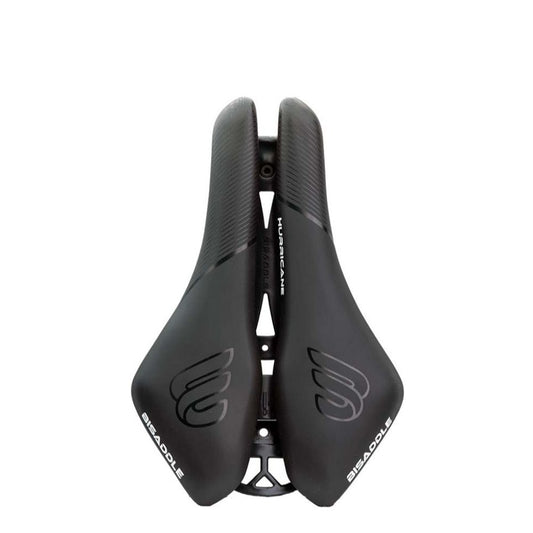
Among companies advancing this technology, BiSaddle stands out with a particularly clever approach. Traditional saddles-even noseless ones-come in fixed shapes. If it doesn't match your unique anatomy, you're out of luck.
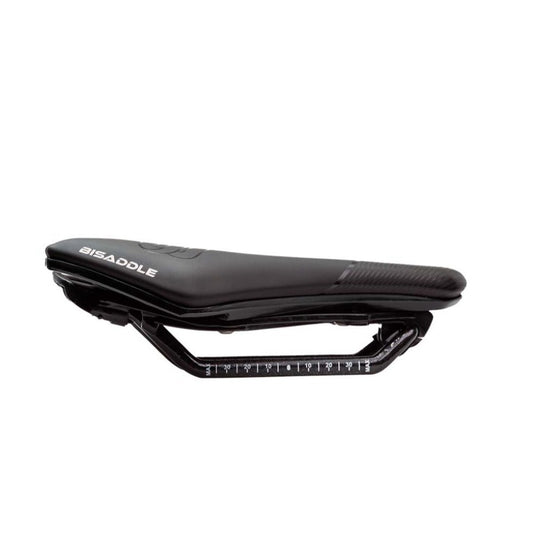
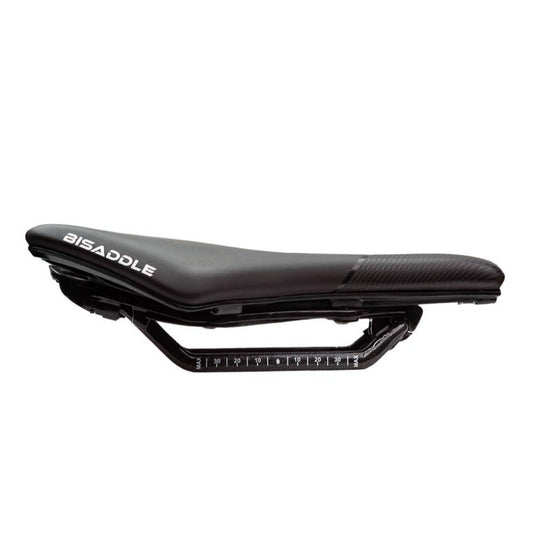
BiSaddle tackled this problem with an adjustable design allowing riders to customize width, angle, and profile. Their saddle consists of two independent halves that can slide and pivot to match your specific anatomy.
Having tested their system extensively, I can confirm it's genuinely effective. The technical specs are impressive:
- Width adjustment range from approximately 100-175mm
- Independent angle adjustment for each side
- Multiple effective saddle profiles from flat to curved
- User-adjustable at home with basic tools
This adjustability addresses one of the fundamental challenges with any saddle design-human pelvises vary tremendously. What works perfectly for one rider might be torture for another with slightly different anatomy.
The Performance Connection: It's Not Just About Comfort
Here's where things get really interesting for performance-minded cyclists. The benefits of noseless saddles extend far beyond simple comfort.
When traditional saddles compress blood vessels and nerves in your perineal region, your body responds in ways that directly impact performance:
Your autonomic nervous system reacts. Compression of the pudendal nerve can trigger a stress response similar to "fight or flight," elevating heart rate and respiration-wasting precious energy.
Blood flow gets redirected. As your body tries to restore circulation to compressed tissues, blood is diverted away from working muscles, potentially reducing power output.
You recruit unnecessary muscles. Unconsciously shifting to alleviate pressure activates stabilizing muscles that would otherwise stay relaxed, creating additional energy expenditure.
Hormonal changes occur. Studies show prolonged perineal pressure can temporarily reduce testosterone levels in male cyclists, potentially impacting recovery and training adaptation.
A 2023 study in the Journal of Sports Sciences quantified these effects, showing that during two-hour steady-state efforts, riders on noseless saddles demonstrated:
- 4% lower average heart rate at identical power outputs
- Reduced activation of non-propulsive muscles
- Lower post-exercise cortisol levels
- Better power maintenance in the final 30 minutes
These findings explain why many endurance athletes have embraced noseless designs despite their unconventional appearance-they're not just more comfortable; they're physiologically more efficient.
Where Noseless Technology is Heading
As someone deeply involved in cycling technology development, I'm particularly excited about where noseless saddle design is heading:
Integration with biometric sensors. Prototype "smart saddles" with embedded pressure sensors provide real-time feedback on position and pressure distribution. Imagine your cycling computer alerting you when you're sitting incorrectly!
Advanced materials innovation. Shape-memory polymers and viscoelastic composites are creating saddles that adapt to your anatomy during different riding phases.
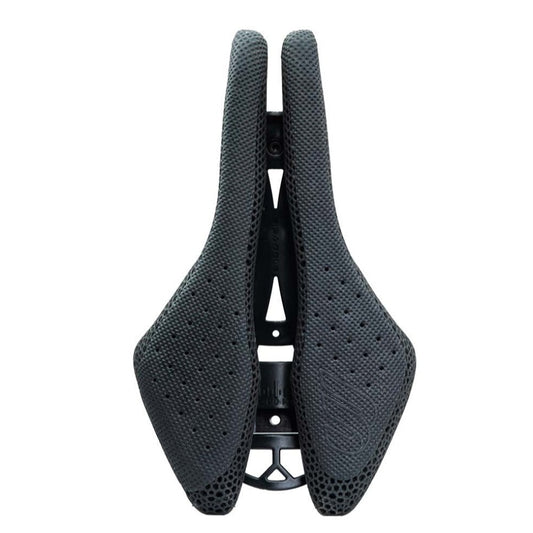
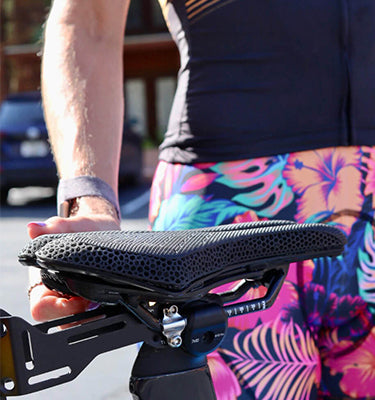
3D-printed custom solutions. Some companies now offer completely custom 3D-printed saddles based on pressure mapping or anatomical scans. BiSaddle's "Saint" model already incorporates 3D-printed surfaces with their adjustable platform.
Discipline-specific designs. We're seeing increasing specialization for different cycling disciplines-designs engineered specifically for gravel, where riders change position frequently, differ from time trial saddles optimized for a single sustained position.
Most significantly, principles from noseless designs have infiltrated mainstream saddle development. Almost every major manufacturer now offers saddles with shorter noses and pressure-relief channels that borrow concepts pioneered in noseless technology.
The Bigger Picture: Medical Innovation Becomes Performance Standard
The evolution of noseless saddles represents one of cycling's most interesting equipment stories-a case where addressing a health concern uncovered unexpected performance benefits.
What began as a medical intervention has transformed our understanding of how saddle design affects not just comfort and health, but performance potential. The technology has overcome cultural resistance through scientific validation and visible results.
For me, after decades in the cycling industry, the noseless saddle story illustrates an important principle: sometimes the most significant performance innovations don't come from marginal aerodynamic improvements or shaving grams, but from better understanding how our bodies function on the bike.
The next time you see one of these distinctive saddles, recognize it not as just a comfort solution, but as sophisticated performance technology representing the intersection of medical science, biomechanical engineering, and athletic optimization.
Have you tried a noseless or short-nose saddle design? Share your experiences in the comments below!