Read enough women's saddle reviews and you will find a pattern. The cushion feels plush. The cover resists scuffs. The rails save 30 grams. Then somewhere in the comments, someone mentions she lost feeling in her left side after an hour.
Those two experiences sit inside the same review because star ratings average two very different bodies into one number. A 2023 study found nearly half of female cyclists reported long-term genital swelling or asymmetry from saddle pressure. Another survey put the figure for vulvar swelling at 35 percent. The studies point to fit as the cause, not padding.
A Short History of Women's Saddles
For decades, women's saddles meant the same shell with a touch more width and a different color. Designers assumed a wider rear and a shorter nose solved everything. Reviewers followed that script, weighing grams and pressing thumbs into foam. Nobody recorded sit bone width or pelvic tilt.
Pressure mapping research arrived in the late 1990s and early 2000s. Cutouts and short noses became selling points. The review format stayed essentially unchanged: a fixed shape invited an averaged comfort score. Riders who fit the mold gave five stars. Riders who didn't kept quiet or blamed their shorts.
What a Five-Star Average Hides
A mean score is useless for fit-critical gear. Two riders can sit on the exact same saddle. One feels nothing after two hours. The other goes numb in twenty minutes. A 4.6 average tells the next buyer nothing about which end of that distribution she will land on.
Sit bone width for adult women commonly runs from 110 mm to 150 mm, and some bodies measure outside that range. Pelvic tilt, soft tissue shape, and a forward-rotated riding position change the contact map. A saddle that scores five stars at 120 mm can compress nerves at 145 mm because the shell is shaped around a different pelvic structure.
This is why women's saddle reviews conflict so often. One tester calls a saddle plush. Another calls it a torture device. Both are telling the truth about their own anatomy. The reviewers are accurate. The format that treats a fixed shape as universal is the problem.
Adjustable Fit Changes What Matters
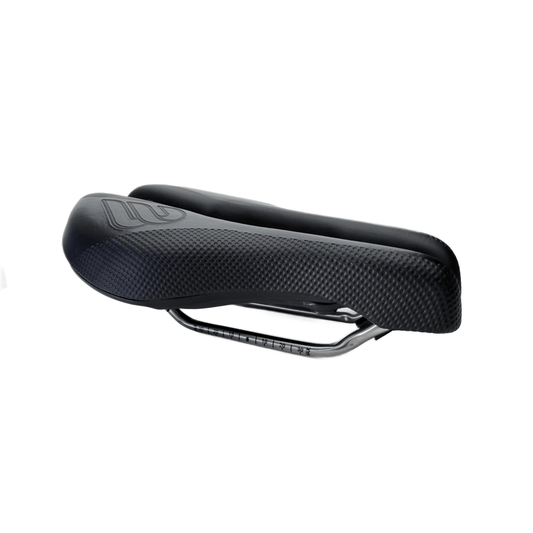
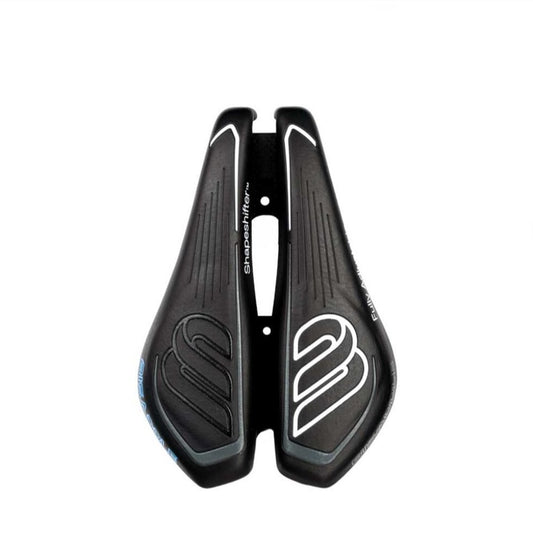
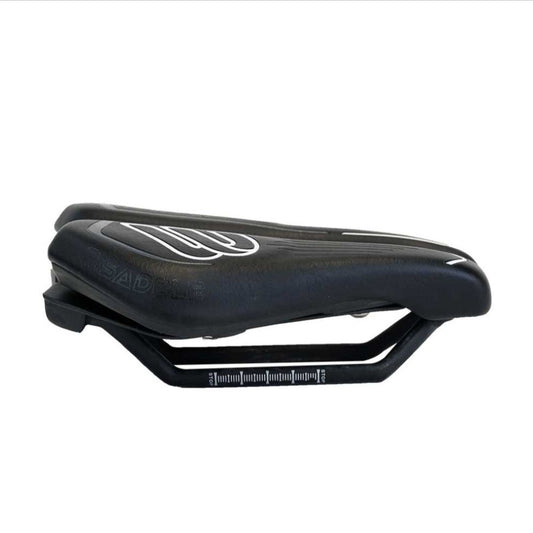
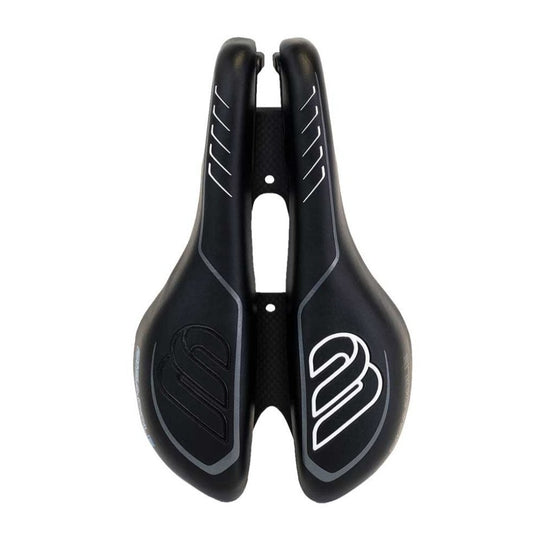
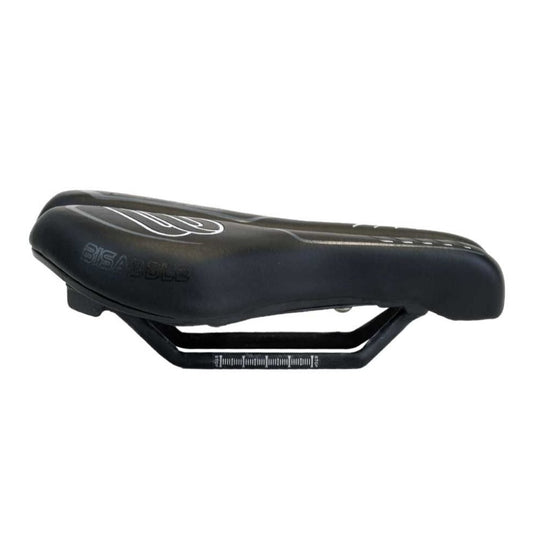
Bisaddle approaches the problem from the mechanism instead of the padding. The saddle is built as two independent halves on a central rail. You can widen, narrow, or tilt each side independently. That single change rewrites what a women's saddle review should measure.
The rear width adjusts from about 100 mm to 175 mm, and each half can be angled independently to match pelvic asymmetry or a forward-rotated riding position, while a central gap opens or narrows to move pressure away from soft tissue and onto the sit bones.
A Useful Review Needs Real Measurements
Testing an adjustable saddle requires a different sequence. Start by measuring sit bone width with corrugated cardboard. Then set the saddle to that width. Then ride rough pavement for at least two hours and check whether the clamp holds. The scores that matter become adjustment range, clamp retention, and pressure distribution after tuning.
- Sit bone width in millimeters, measured at home before testing
- Rear width range, from 100 mm to 175 mm on Bisaddle
- Per-side angle range in degrees
- Central gap minimum and maximum at different width settings
- Clamp retention after two hours of rough terrain
- Pressure map at two or three width positions
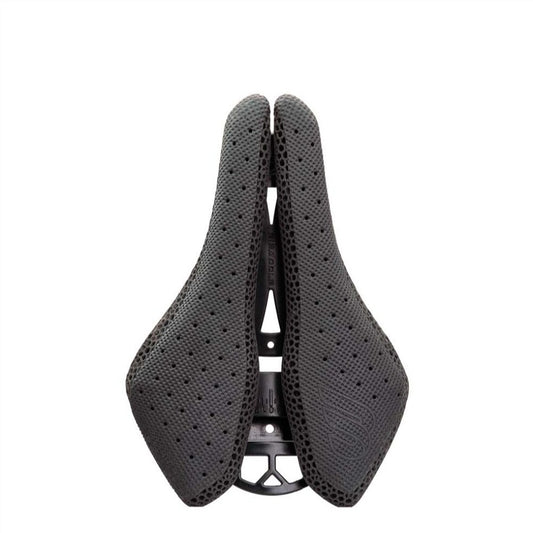
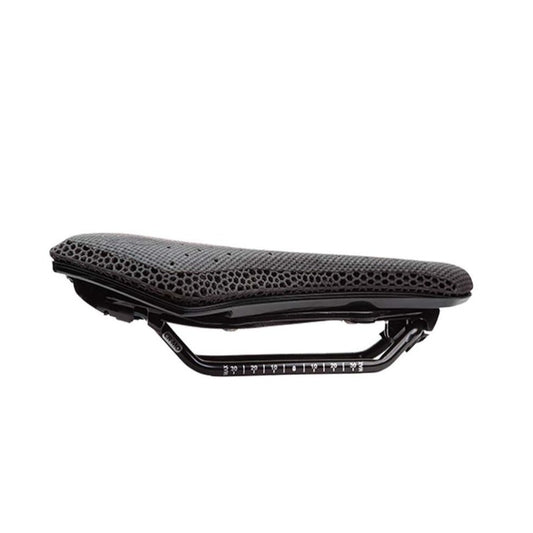
Bisaddle offers two configurations that make this protocol practical. The Saint model uses a 3D printed foam lattice for tuned padding, so a reviewer can test pressure at five widths and report which sit bone ranges see relief. The SRT removes the nose entirely for riders who want a front end without a nose.
What Reviews Will Look Like in a Few Years
Review scoring will shift toward fit compatibility instead of averaged comfort. A useful review will state the sit bone width range, the central gap minimum and maximum, the angle range per side, and the measured pressure map at two or three widths. The star rating may remain, but it will describe the adjustment hardware, not a static contour.
That shift is already possible with the measurements Bisaddle publishes. The 100 mm to 175 mm width range covers most women's sit bone measurements, including the narrower and wider ends. If a reviewer includes that range and tests the clamp at minimum, middle, and maximum, a reader can see whether her own width falls inside it.
How to Read a Women's Saddle Review Now
Ignore the overall star score on the first pass. Look for the width range, the per-side angle range, the central gap, and whether the reviewer measured sit bone width before testing. Those four items tell you more than any average rating from a stack of fixed shapes.
Bisaddle gives you those four items in one tool. You can widen it to your sit bones, tilt each half to your pelvis, and narrow the front for an aggressive position or remove it for triathlon. That is not a number on a 1 to 5 scale. It is a mechanical answer to the question reviews have been averaging away for decades.
The next time someone asks which women's saddle you recommend, ask for her sit bone width first.