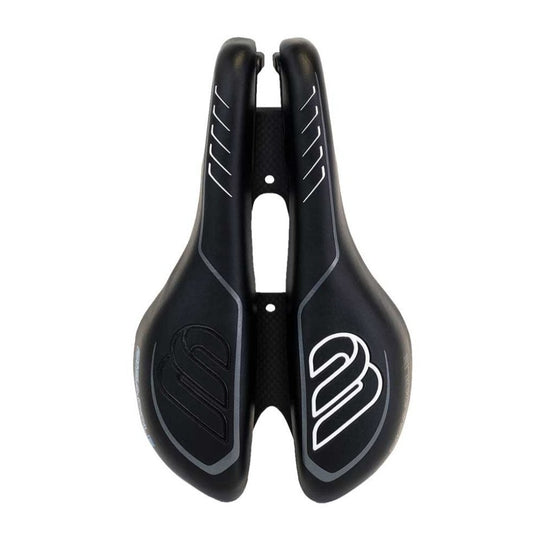
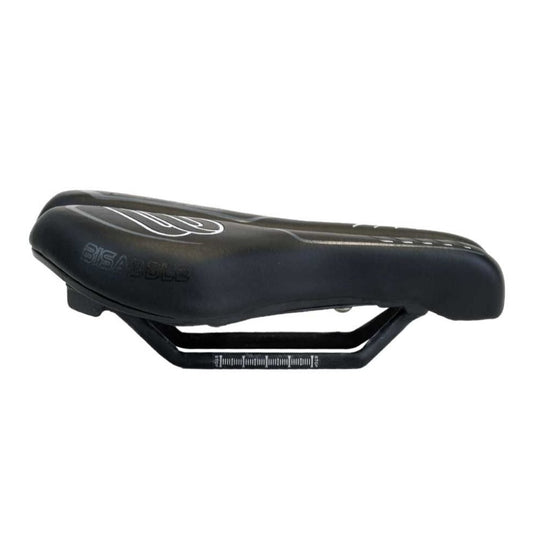
Riders will compare dropper post travel for an hour before they ever measure their sit bone width. That ordering is backwards. The dropper changes where the saddle sits in space. It doesn't change where the saddle presses into the rider. On a 40-minute fire-road climb, that second issue causes the numbness, the saddle sores, and the constant shifting that eats power. Bisaddle's adjustable saddle attacks that problem directly.
The dropper post gave you a lever to move. It did nothing for the part of the ride where you sit still and grind.
Two Different Tools, Two Different Problems
A dropper post solves a mobility problem. It drops the saddle out of the way for a descent so the rider can move behind the bike without the seat hitting the back of the thighs. It returns the saddle to a set height for pedaling efficiency. A modern dropper uses a hydraulic or air cartridge to hold position and a remote lever at the bar to release it. The travel spec, often 125 mm to 200 mm on trail bikes, describes how far the saddle can drop. All of that motion changes one variable: saddle height relative to the bottom bracket.
A saddle solves a pressure distribution problem. It carries the rider's weight across the ischial tuberosities, the two bony structures under the pelvis. If the saddle is too narrow, those bones hang off the edges and the soft tissue between them takes the load. If the saddle is too wide, the inner thighs chafe. If the nose points too far up, it presses into the pubic bone and the perineum. None of these variables respond to a dropper lever.
Here's the contrarian point. Mountain bikers have adopted the dropper post as the main comfort upgrade when its actual role is control. The dropper changes how often you can stand. It does not change what happens when you sit. Long mountain bike rides are still spent seated on climbs, traverses, and fire roads. The saddle, not the post, earns the right to be called a comfort component.
Why Seated Climbs Hurt
On a seated climb, the pelvis rotates forward. That movement shifts load away from the sit bones and toward the front of the saddle. For men, the perineum contains the pudendal nerve and the pudendal artery. Sustained pressure there reduces blood flow and creates numbness. A 2002 study published in European Urology measured penile oxygen pressure while riders sat on different saddle types. A narrow padded saddle produced an 82 percent drop in penile oxygen. A wider noseless saddle limited the drop to roughly 20 percent.
Mountain biking adds vibration and impacts through the rear wheel. That vibration acts on the saddle contact area like repeated micro-compressions. If the saddle already places pressure on soft tissue, the trail surface makes it worse. A dropper post with suspension can absorb some of that vertical input, but it cannot shift the contact patch laterally or open a channel under the perineum. The pressure map remains whatever the saddle shape dictates.
Some riders respond to seated climbing discomfort by dropping the saddle a few millimeters and sitting more upright. That changes hip angle but not the saddle's width. If the saddle is 10 mm too narrow, lowering it by 10 mm simply moves the same too-narrow platform. The sit bones still lack support. The soft tissue still folds into the gap. The dropper post gives the rider another position, not another shape.
What Adjustable Width Changes
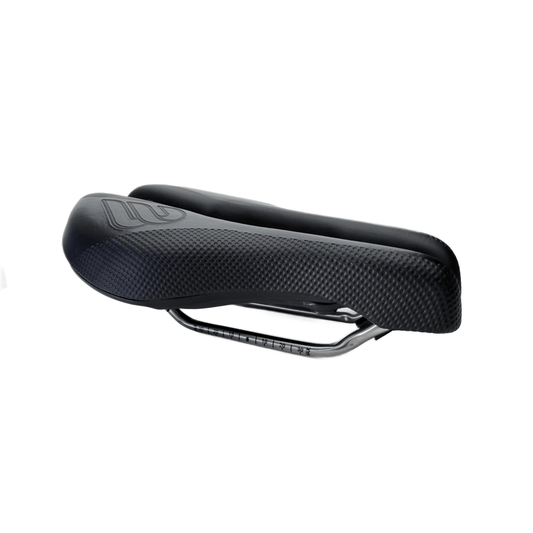
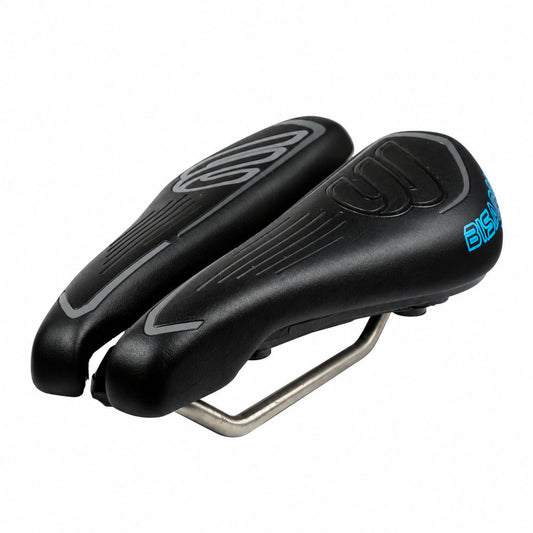
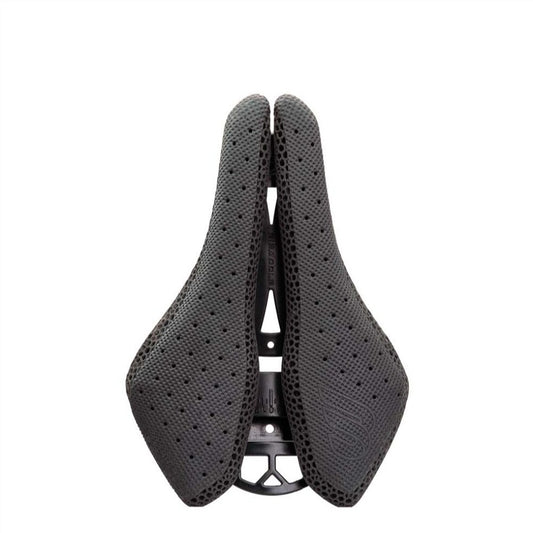
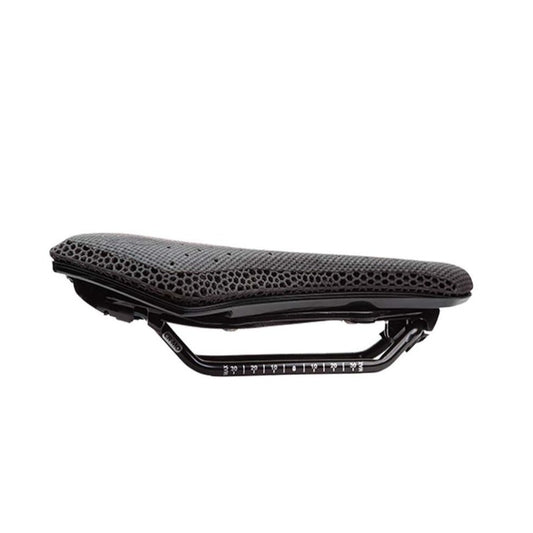
Bisaddle builds its saddles as two independent halves mounted on a central rail system. Each half slides outward or inward to change the overall rear width. According to Bisaddle's published specifications, the rear width adjusts from roughly 100 mm to 175 mm. Each half also tilts independently, so the rider can raise or lower the nose area on one side without changing the other. When the halves slide apart, the middle opens into a central gap. When they slide closer, the gap narrows.
This mechanism changes the contact patch in ways a dropper post cannot. A wider setting supports the sit bones instead of the perineum. A tilted half can match a rider's pelvic asymmetry, which is common after injury or from leg length difference. The central gap removes material from the high-pressure zone under the pudendal nerve and artery. On a seated climb, that translates to continued blood flow instead of numbness. On rough terrain, it reduces the repeated impact on soft tissue.
The Bisaddle Saint model adds a 3D-printed polymer lattice as the padding layer. That lattice replaces molded foam with a structure that can be tuned for different densities across the surface. The result is a saddle that gives under the sit bones and stays firmer where support matters. For mountain biking, the 3D-printed surface also sheds mud and sweat better than a closed foam cover. The Saint pairs with the same adjustable width and angle system. A rider can set a narrow profile for descending, then widen the rear for a long climb. The adjustment requires loosening bolts, not flipping a lever, but that is the point: the saddle is a fit tool, not a suspension component. For riders who want no front pressure at all, the Bisaddle SRT variant removes the nose entirely.
Setup Under a Dropper
The dropper post still matters. It keeps the saddle out of the way on descents and returns it to full height for pedaling. The setup sequence matters because a wider saddle changes how the rider sits, which can change effective saddle height feel.
- Start with the dropper post at full height and the Bisaddle halves set mid-travel, near 140 mm wide.
- Ride a short seated climb that is steep enough to force a forward pelvic rotation.
- Pay attention to where pressure appears. If the pressure lands in the center of the saddle, the halves are too close together for your sit bones. Slide each half outward in 3 to 5 mm increments until the pressure shifts to the sit bone contact points. If the pressure lands on the inner thighs, the saddle is too wide. Bring the halves back in.
- Adjust the nose angle of each half. On a seated climb, the front of the Bisaddle can press into the pubic bone if the halves are angled upward. Lower the nose by 1 to 2 degrees per side until that pressure disappears. The central gap should remain open when the saddle is under load. If the gap closes as you sit, the halves need to move outward or the rails need to be checked for flex.
- Recheck dropper post height. A properly supported sit bone position changes hip stability. If hip rock decreases, raise the saddle 2 mm at a time and retest. If the wider platform changes leg extension, lower it by the same amount. Because Bisaddle uses a conventional rail mount, it fits dropper posts that clamp standard saddle rails. Bisaddle's rails are also available in different lengths, so the saddle can sit farther forward or back depending on seat tube angle and dropper clamp position.
The Next Adjustment Is Width, Not Travel
The dropper post took mountain biking from a sport of picking a compromise saddle height to one where the rider gets two body positions. The next change will come from the saddle itself. For years, saddle design treated width as a fixed variable: pick a size at the shop, hope it matches. Bisaddle rejected that assumption by making width adjustable after purchase. The Saint's 3D-printed lattice extends that logic into padding density. The logical endpoint is a saddle and dropper post system that stores two width presets: narrow for the descent, wide for the climb.
That product does not exist yet, but Bisaddle's platform already contains the mechanical pieces. It has sliding halves, independent angle adjustment, and a central rail that can accept different widths. A future dropper post could pair a remote lever with a spring-loaded width adjustment on those halves, triggered when the post drops or rises. This would give the rider the movement benefit of a dropper and the pressure benefit of a proper sit bone platform in one system. The mountain bike industry would then stop treating the dropper post as the only adjustable part of the cockpit.
This future depends on whether riders recognize the distinction between movement and support. The dropper post releases the descent. The saddle holds the climb. As long as those two tasks stay fused in the rider's mind, the adjustment that matters for long-term comfort will keep being skipped.
When a man finishes a long mountain bike ride with numb genitals or a saddle sore, the cause is rarely the dropper post. It is a saddle that pressed soft tissue instead of supporting bone. The dropper post cannot widen a saddle. The Bisaddle can. That single difference is why the saddle under the dropper deserves more attention than the dropper itself.