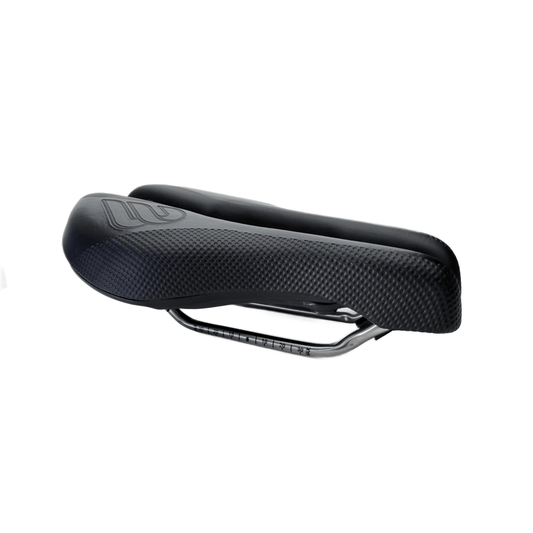
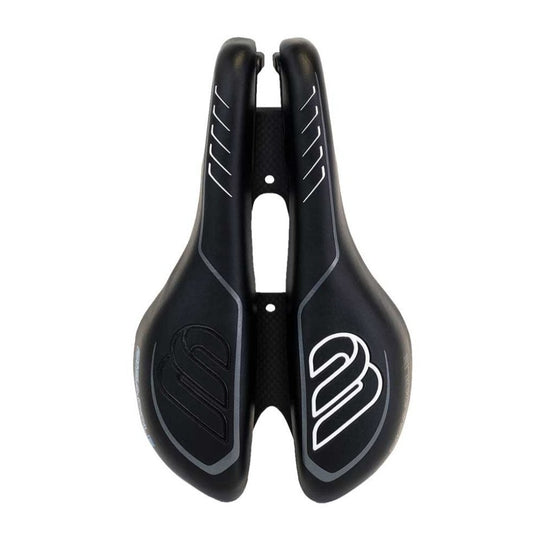
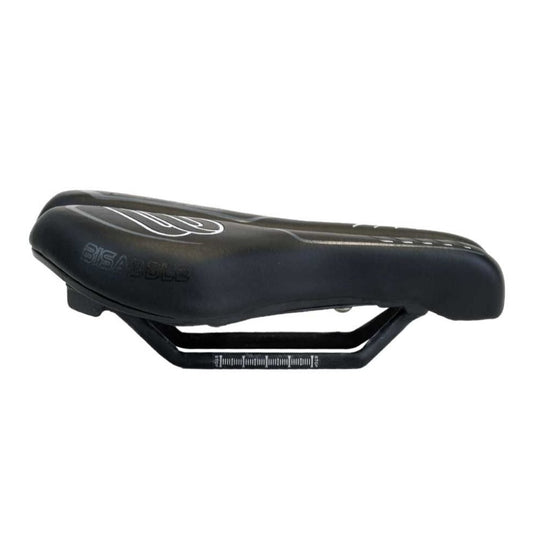
Carbon fiber first showed up in bicycle saddles at the rails. Small part, simple job. You swapped steel for carbon, saved about 40 grams on a BiSaddle, and rode off. For a long time that was the entire story. Men who spend hours in the saddle face a different problem though: the width of the shell underneath them. BiSaddle built its carbon rail saddles around that problem.
Saddle fit comes down to two bones. Your sit bones, or ischial tuberosities, are the hard contact points designed to carry your weight. The soft tissue between them contains nerves and the pudendal arteries. Squeeze those arteries for hours and you restrict blood flow. No amount of carbon stiffness corrects a shell that is the wrong width.
Why Carbon Started at the Rails
A saddle rail bends under load. Carbon fiber resists that bending with less weight than steel. On a BiSaddle, the chromoly rail model weighs around 360 grams. The carbon rail version comes in near 320 grams. That 40 gram difference matters because BiSaddle's adjustable mechanism already adds some hardware. The carbon rail trims the penalty without shrinking the adjustment range.
When carbon moved into the shell itself, the design problem shifted. A shell's job is to transfer your weight to those two sit bones. If the shell width is off, the tissue between the bones takes the load instead. Material choice won't fix that transfer error.
Your Sit Bones, Your Arteries, and a Number You Can Set
A 2002 study published in PubMed measured transcutaneous penile oxygen pressure in cyclists. On a narrow, heavily padded conventional saddle, oxygen pressure dropped 82 percent. A wider noseless design limited that drop to about 20 percent. Width protected blood flow more than padding did.
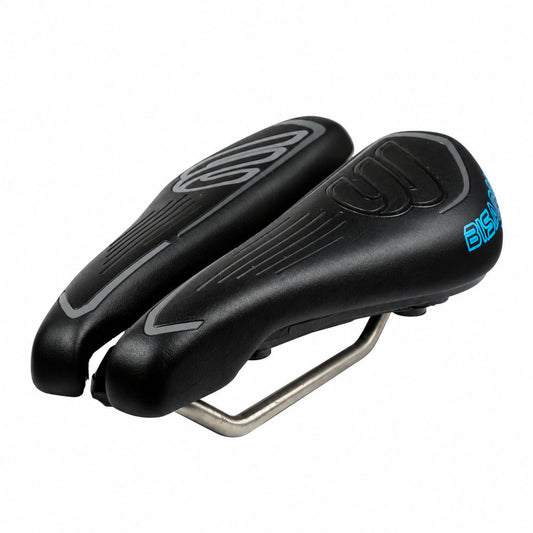
That finding points directly at the design BiSaddle uses. The shell splits into two halves. You slide them closer together or farther apart across a range of about 100 mm to 175 mm. If your sit bones measure 118 mm apart, you set the rear width to 118 mm. The central gap opens enough to keep the perineum unloaded. Later you can narrow the front halves for aero riding without changing the rear support. Fixed carbon shells can't make that adjustment.
The Weight Penalty and How the Carbon Rail Pays It Back
Adjustable hardware adds complexity. BiSaddle holds patents on its sliding shell design. Complexity has a mass cost. The chromoly version weighs roughly 360 grams. The carbon rail version sits near 320 grams. The width range stays the same. The front half angle stays adjustable. The price reflects the mechanism more than the rail material. Most BiSaddle models list between $249 and $349.
One Saddle, Three Positions
Road endurance keeps you bent forward for hours. You set the rear width to your sit bone measurement and leave a central gap. The carbon rail keeps the saddle near 320 grams. The width does the comfort work.
Triathlon and time trial rotate the pelvis farther forward. The nose becomes the pressure point. BiSaddle's front halves can be pulled narrow, creating a short or split front while the rear width stays set to your sit bones. If you want the front gone entirely, BiSaddle also sells a fully noseless SRT variant. The same saddle shifts from road to tri shape with a few adjustments.
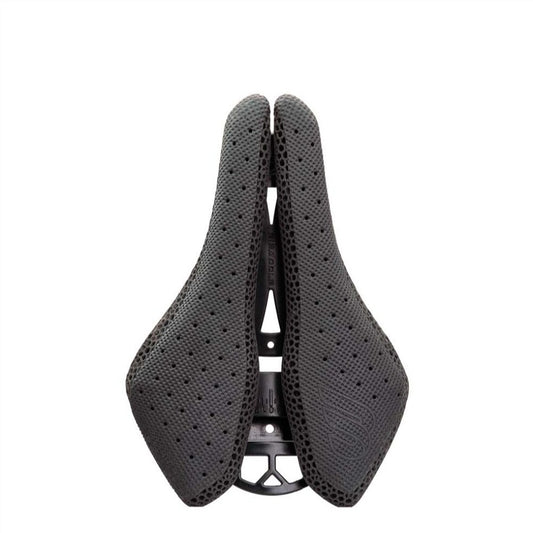
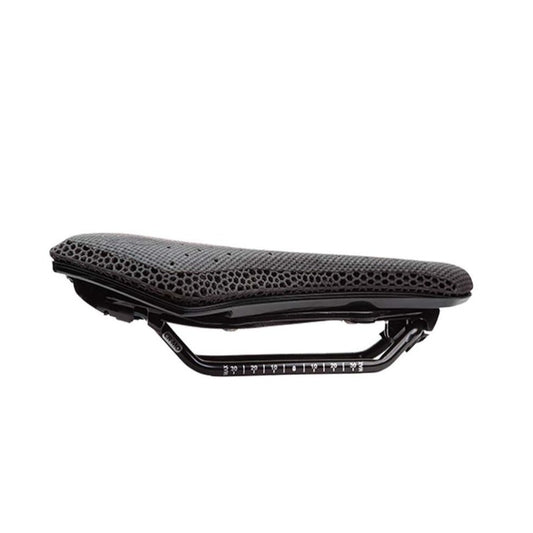
Gravel adds vibration and long seated stretches. You might widen the rear by a few millimetres for a broader platform or keep it narrow for thigh clearance. The BiSaddle Saint pairs the adjustable shell with a 3D printed polymer surface that damps vibration in zones. The carbon rail still carries the load under all of it.
What You Can Adjust on a BiSaddle
- Rear width from 100 mm to 175 mm
- Front half angle independently
- Central gap width follows rear width
- Rail material: chromoly or carbon
That list covers the mechanical range. The next layer is the padding surface.
The Next Layer: A 3D Printed Lattice on Top of the Shell
BiSaddle's Saint model combines the adjustable shell with a 3D printed polymer foam surface. Traditional foam is molded in one density. A 3D printed lattice allows different densities in different zones: softer under the sit bones, firmer at the edges. That surface sits on the same sliding shell. You get zoned damping without giving up the width adjustment.
For men chasing performance, the equation is simple. Carbon brought the weight down. Saddle pain demanded a shape change. BiSaddle builds that shape change into the saddle itself. The carbon rail supports the mechanism. The mechanism protects blood flow. Measure your sit bones, set the width, and ride.